Blog
How specialized startup tools work alongside CTMS
The coexistence pattern: what specialized startup platforms add that OnCore, Medidata, and Veeva aren’t designed to do.
Read article
TrialConnx connects feasibility, budget, contract, IRB, ownership, and bottlenecks across every startup study.
Startup is a workflow, not a status meeting.
TrialConnx makes the path from pre-award to activation visible: what stage each study is in, who owns the next action, and where work is slowing down.
Purpose-built around the startup path from intake to activation.
See whether the next action sits with your team, sponsor/CRO, PI/department, IRB, contracts, or another owner.
Keep the audit trail and cycle-time patterns that disappear when startup is run through email.
CTMS platforms like OnCore, Veeva, and WCG were built for trial execution: visit tracking, monitoring, EDC handoff. The pre-conduct workflow is a different problem: intake, feasibility, budget, contract, IRB, and activation. That’s the gap TrialConnx fills.
See how TrialConnx fits with your CTMSEvery team starts somewhere. Most start with one of these, and most outgrow it the moment study volume climbs.
If you’re already using a CTMS
Run them together: startup through TrialConnx, execution through your CTMS.
If you’re on Excel or homegrown tools
Stop reconstructing study status from email threads.
If you’re adapting Monday, Jira, or Smartsheet
Stop bending a tool that wasn’t designed for clinical research.
Stop tracking studies in your head, on sticky notes, and across email threads. TrialConnx gives every team a shared, current picture.
Portfolio-wide view of every study’s startup status. No spreadsheet manifest. No Monday-morning audit before you can answer a stakeholder question.
Custody tracking shows where each activity sits (internal team, sponsor, IRB) and how long it’s been there. Find what’s stuck without asking.
Full history of who changed what, when, and why, on every activity. Comply without reconstructing the timeline from memory.
Cycle time, custody duration, and bottleneck patterns, measured rather than guessed. Improve the next study from what you learned on the last one.
A few of the things teams want to know before a demo. The full list lives on our FAQ.
Study startup: feasibility and site selection through budgets, contracts, IRB, and activation. Once a site activates and patients enroll, your CTMS and EDC take over.
Vendors add capacity. TrialConnx gives you the view across all of it, so you see where every study stands and who owns the next step, whether your team or an outside vendor is doing the work.
It’s API-first and built to sit alongside your existing systems. Your CTMS stays the system of record for trial conduct; TrialConnx organizes the startup work that leads up to it and hands off the relevant data at activation.
Yes. One view of every study in startup: where it stands, what’s blocking it, and which milestones are at risk, without compiling status from spreadsheets and email.
Different teams, same system, built for the workflows each one actually runs.
For AMCs running 100-250 trials a year. Run feasibility, IRB, contracts, and activation in one system instead of five spreadsheets and a dozen email threads. Scale without adding headcount.
For AMCsFor sites running 20-50+ active studies. Compete for trials with proof of operational discipline. Show sponsors a track record of activation timelines, not a promise.
For SitesCoordinate site activation across portfolios. Real-time startup metrics, predictable timelines, fewer status meetings with site teams.
For CROs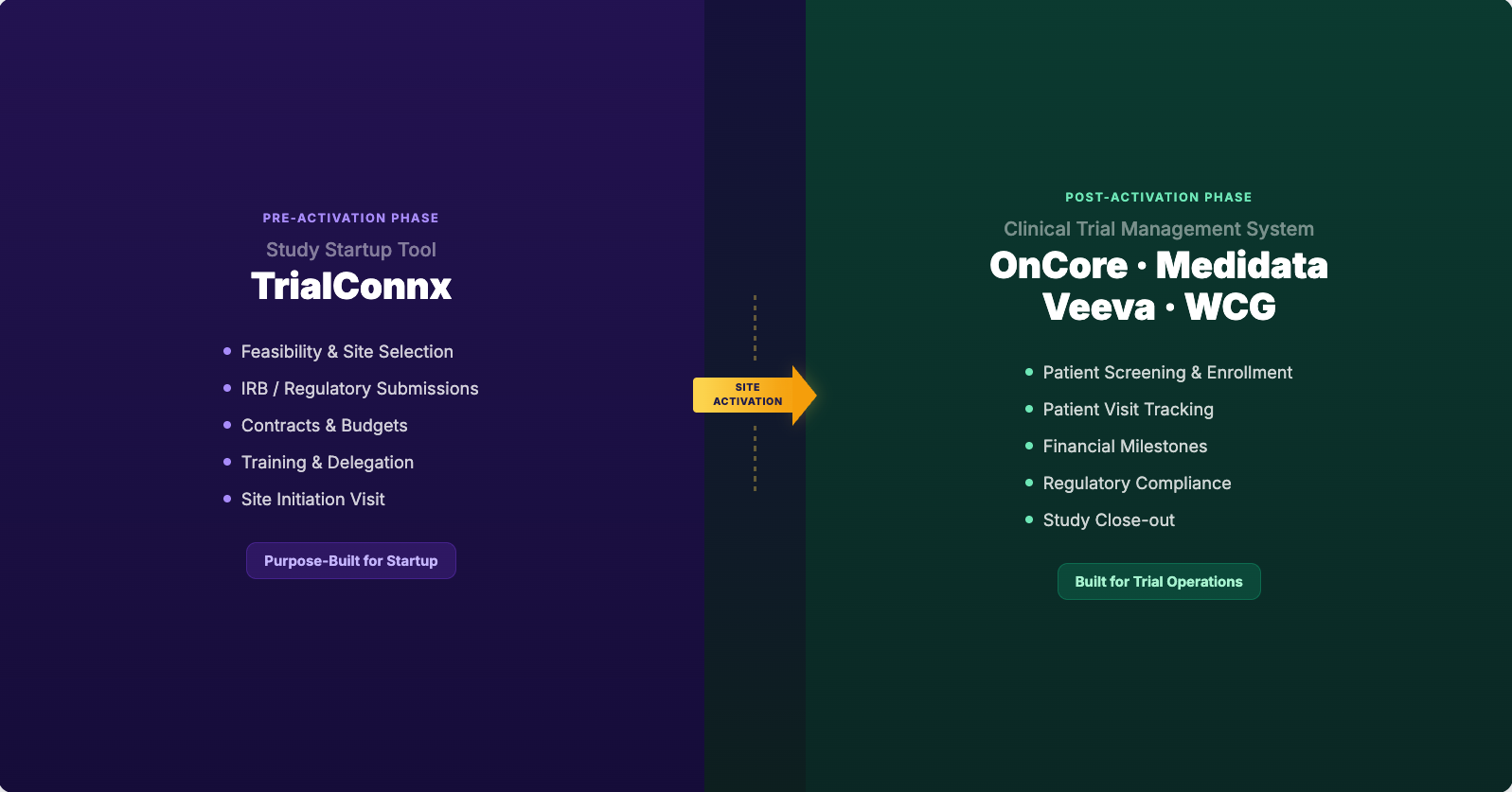
Blog
The coexistence pattern: what specialized startup platforms add that OnCore, Medidata, and Veeva aren’t designed to do.
Read article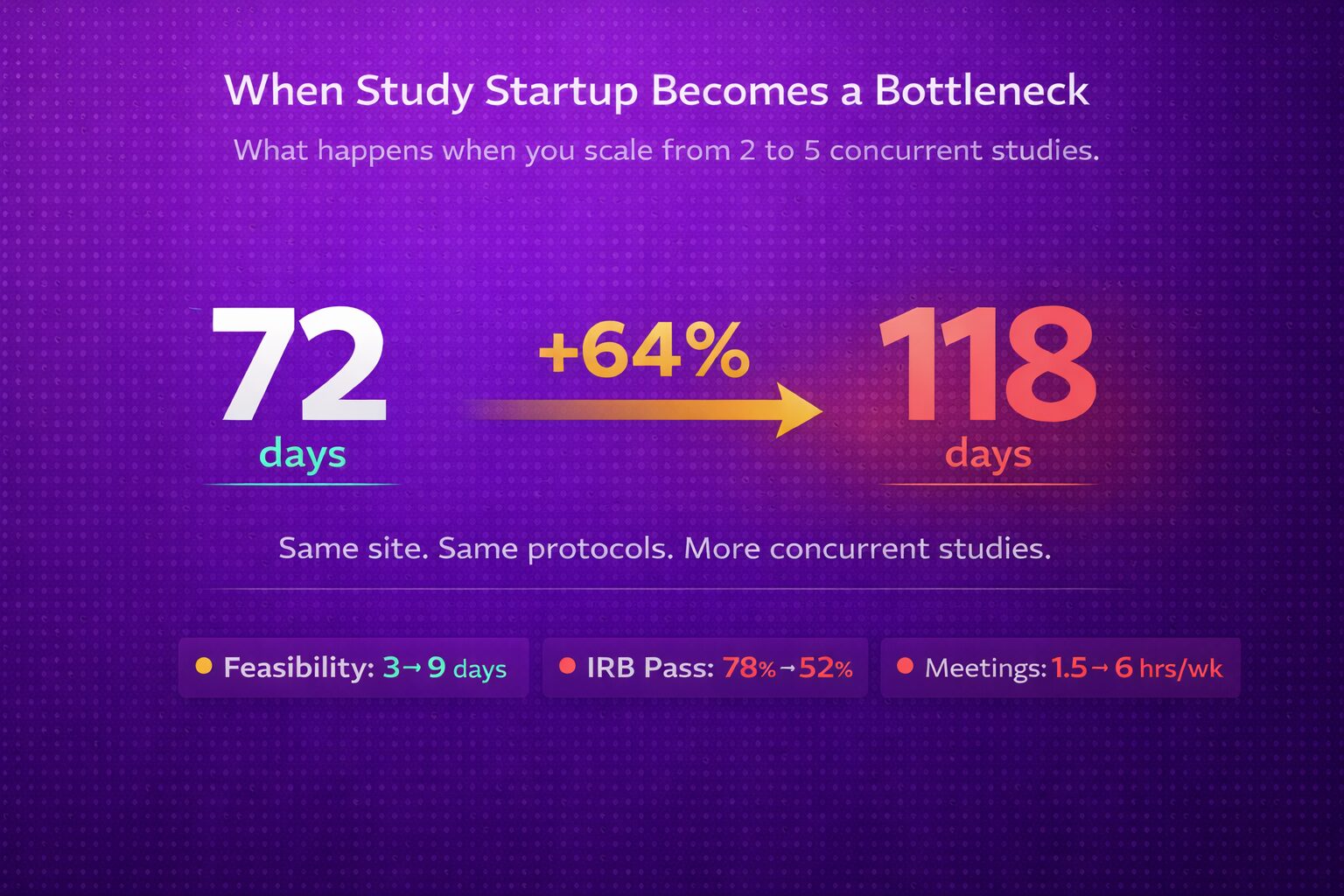
Blog
What collapses when site startup scales from one study to five, and the operations changes that pull cycle time back down.
Read article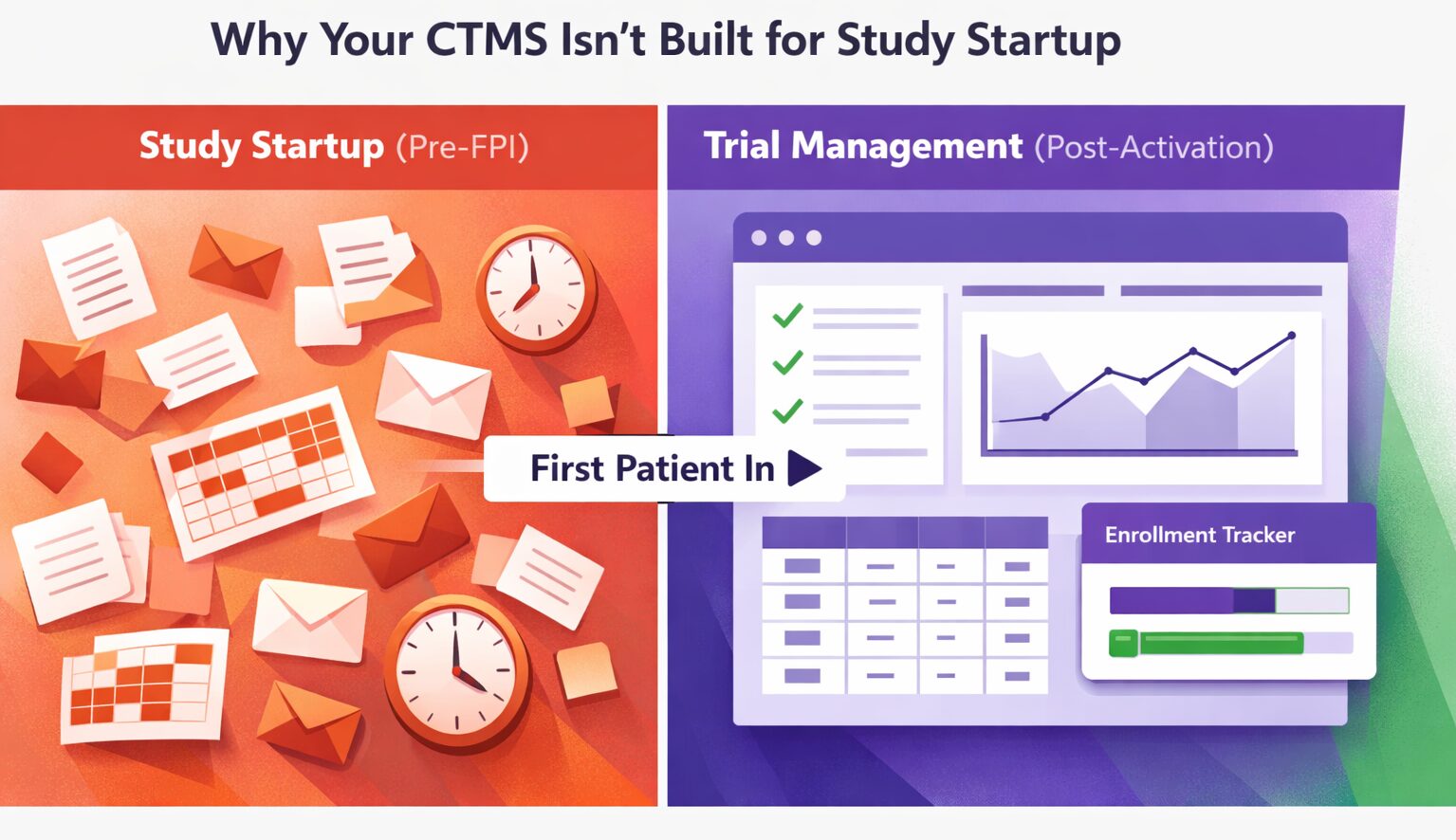
Blog
The structural reason execution-grade CTMS systems leave activation teams in spreadsheets, and what to do about it.
Read articleSee where your startup is leaking days across pre-award, IRB submission, and site activation.
Find startup bottlenecks