
Why SOPs Matter in Study Startup

If your clinical trial startup process still lives in inboxes, spreadsheets, and scattered notes, you’re not alone. Many research sites, academic medical centers, and hospital systems still manage startup tasks with ad hoc tools — and the result is predictable: delays, missed deadlines, and frustrated sponsors.
That’s where a study startup SOP (Standard Operating Procedure) comes in.
An SOP for study startup is more than just a compliance document. It’s a step-by-step playbook that helps your team move faster, stay consistent, and avoid costly mistakes. Sponsors notice when a site is well-organized. A clear, repeatable process not only shortens timelines but also builds sponsor confidence that your site can deliver.
In this guide, you’ll get:
- A free Clinical Trial Startup SOP Template
- A breakdown of what every SOP should cover
- Practical setup tips to make your SOP stick
- A clear roadmap for improving startup timelines
By the end, you’ll have a practical clinical research SOP guide you can use immediately — no blank-page drafting required.
What a Good Study Startup SOP Should Cover
A startup SOP is essentially your team’s map from feasibility to site initiation. Without one, responsibilities blur, tasks get missed, and timelines stretch. With one, the path is clear, responsibilities are defined, and delays shrink.

Here are the key stages every clinical trial SOP template should include — and why they matter:
1. Feasibility
When a sponsor sends a feasibility questionnaire, speed matters. Responding in 3–5 days instead of 15+ can be the difference between winning or losing the study.
A study startup SOP ensures that:
- The right contacts are looped in immediately
- PI interest is confirmed early
- Required documents (CVs, lab certifications, site capabilities) are gathered in advance
👉 Without an SOP, sites often scramble at the last minute — and sponsors move on to faster competitors.
2. Budget Development
Budgets often stall because finance, investigators, and legal aren’t aligned. A clinical research SOP guide prevents this by:
- Defining when finance reviews should start
- Setting expectations for PI feedback turnaround
- Establishing a structured negotiation process
👉 Sites that standardize budgets reduce back-and-forth and avoid weeks of idle waiting.
3. Contract Negotiation
Contracts are infamous for dragging timelines. A startup SOP helps by flagging dependencies:
- Legal doesn’t wait for a signed budget
- Required institutional approvals are triggered early
- Negotiation steps are clearly tracked
👉 Without this structure, contracts sit idle — sometimes for weeks — because teams are waiting on each other without realizing it.
4. IRB Submission
Institutional Review Board (IRB) submissions are a critical step, and a single missing form can reset the clock.
Your clinical trial standard operating procedure should checklist:
- Required attachments (protocol, informed consent forms, investigator CVs)
- Signatory responsibilities
- Submission deadlines and reminders
👉 This prevents rejections and resubmissions that waste valuable time.
5. Regulatory & Training
Sponsors expect sites to maintain current documentation and training. An SOP ensures that:
- Good Clinical Practice (GCP) certificates are tracked
- Investigator CVs are updated annually
- Delegation logs and regulatory binders are reviewed proactively
👉 Instead of rushing to update records right before site initiation, your team stays always-ready.
6. SIV Readiness
Before the Site Initiation Visit (SIV), every box must be checked. SOPs help confirm:
- All staff have completed required training
- Contracts and budgets are executed
- IRB approvals are in place
- Site activation checklists are signed off
👉 This avoids the dreaded last-minute scramble to pull together missing documents just days before activation.
Download the Free SOP Template (and Make It Yours)
Building an SOP from scratch takes time — and many sites never get past version 1.0. That’s why we’ve created a ready-to-use Clinical Trial Startup SOP Template.
Inside, you’ll find:
- ✅ A pre-filled task list covering feasibility, budget, contracts, IRB, regulatory, and SIV
- ✅ Role-based responsibilities so every task has an owner
- ✅ Timeline benchmarks aligned with sponsor expectations
- ✅ Editable sections so you can tailor it to your site’s workflows

📥 Download the Free SOP Template
Think of this template as a jumpstart. You can implement it immediately, then refine over time to reflect your site’s specific needs.
Setup Tips to Make the SOP Actually Work
Even the best SOP will fail if it gathers dust in a binder. The secret to success is adoption. Here are five practical ways to turn a clinical trial SOP template into a living guide:

1. Assign Clear Owners
Every task must have a name attached. If your SOP just says “Submit IRB documents,” who does that mean? The coordinator? The regulatory specialist? Without clarity, tasks fall through the cracks.
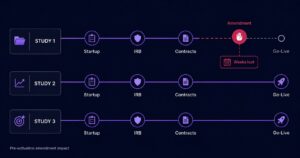
2. Map Dependencies
Many startup tasks can (and should) run in parallel. For example:
- IRB prep doesn’t need to wait for contracts
- Budget negotiations can overlap with feasibility
Mapping dependencies keeps your timeline moving instead of waiting for one stage to fully finish before starting the next.
3. Build in Reminders
Weekly huddles, shared dashboards, or calendar reminders all help prevent tasks from stalling. Some sites have cut contract turnaround times by 10+ days just by introducing automated reminders.
4. Set Realistic Timelines
Your SOP should be ambitious but achievable. If you promise a 3-day turnaround on budgets but finance consistently needs 7–10, you’ll frustrate staff and miss deadlines. Balance sponsor-friendly timelines with staff capacity.
5. Keep It Digital
Printing SOPs guarantees they’ll get forgotten. Instead, make your SOP accessible:
- Store it in a shared drive or project management tool
- Track tasks in a spreadsheet or workflow platform
- Update it regularly so staff see it as an active resource
👉 Small adjustments like these transform an SOP from policy into practice.
Why SOPs Improve Sponsor Confidence
A clinical trial SOP template isn’t just about internal efficiency — it shapes how sponsors view your site.
Sponsors ask themselves:
- Can this site activate quickly?
- Will documents and training be complete on time?
- Do they have reliable processes, or will I need to chase them?
A site with a clear study startup SOP sends a strong message: “We’re organized, predictable, and sponsor-ready.”
This increases your chances of being selected for more studies, especially high-value ones where timelines are tight.
Common Mistakes Sites Make with SOPs

To get the most from your SOP, avoid these pitfalls:
- Overcomplicating – A 40-page SOP won’t get read. Keep it lean, clear, and actionable.
- Ignoring updates – Regulations and sponsor expectations change. Review SOPs annually to stay current.
- One-size-fits-all – A community site may need a different level of detail than a large AMC. Customize accordingly.
- No accountability – If tasks aren’t assigned, nothing gets done. Every step needs an owner.
- Treating it as “compliance-only” – SOPs should be about speed and efficiency, not just ticking regulatory boxes.
Action Plan
Whether you’re activating five studies or fifty, the right clinical research SOP guide turns startup from chaos into coordination.
Here’s your action plan:
- 📥 Download the Clinical Trial Startup SOP Template
- 🧑🤝🧑 Share it with your team
- 🚀 Use it to standardize workflows, shorten timelines, and build sponsor confidence
“The best SOP isn’t the one that lives in a binder — it’s the one your team uses every day.”