Prefer the visual version? View the slide deck ↓
The short version
Pre-activation protocol amendments are one of the largest and least measured sources of delay in trial activation. They most often add 4 to 6 weeks, and nearly 1 in 5 sites report 10 weeks or more (AACI, 2026). The delay is rarely the science. It is coordination: document readiness, version control, and turnaround between sites, sponsors, CROs, and IRBs. The fix reduces to three capabilities a site can build for itself: shared readiness, shared language, and a shared clock. The harder truth underneath: those capabilities get difficult to hold across concurrent startups unless something holds the state.
Study startup has quietly become its own discipline. The work of getting a trial ready to open, the regulatory packages, the budgets, the contracts, the system builds, has outgrown the informal way most sites still run it. Nothing exposes that gap faster than a protocol amendment that lands after the startup package goes out but before the site opens to accrual.
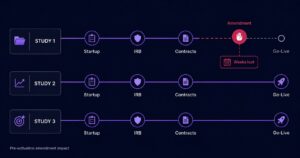
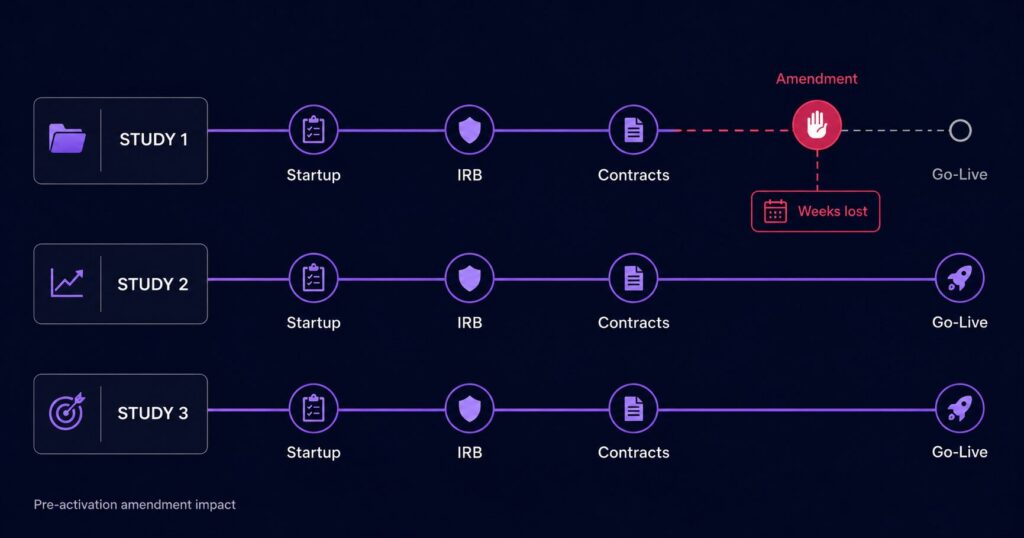
The amendment itself is often small. The damage is in everything that has to re-sync around it. The numbers bear it out: most sites handle 3 to 10 pre-activation amendments a month, and those amendments most often add 4 to 6 weeks to activation (AACI, 2026). The symptom is a delay. The cause is that startup has become a coordination problem most sites have no system for.
First, the proof
The data is blunt enough to settle the “is this a real problem” question in one line.
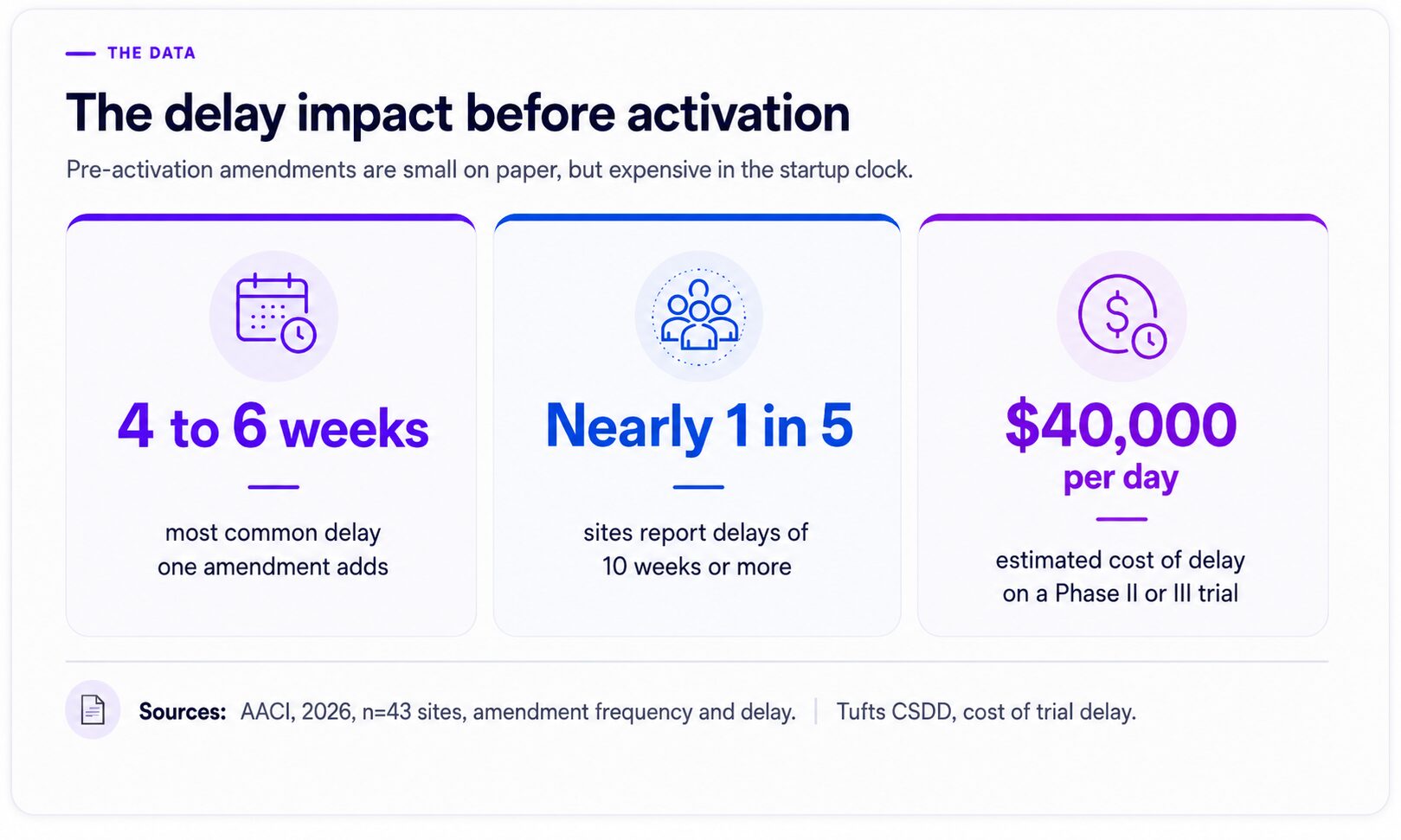
A trial that has not opened yet, that has not screened a single patient, is already absorbing that. And the cause is rarely the science. The damage is in everything that has to re-sync around a change, with no shared way to manage the re-syncing. That pattern, where the coordination load rather than the clinical work sets the pace, is the same one we traced in When Study Startup Becomes a Bottleneck.
The fix is three capabilities
The emerging guidance on amendments runs to a list of recommendations, and a list is how good ideas stall in a startup queue. Distilled, it comes down to three capabilities. Build these and the rest follow.
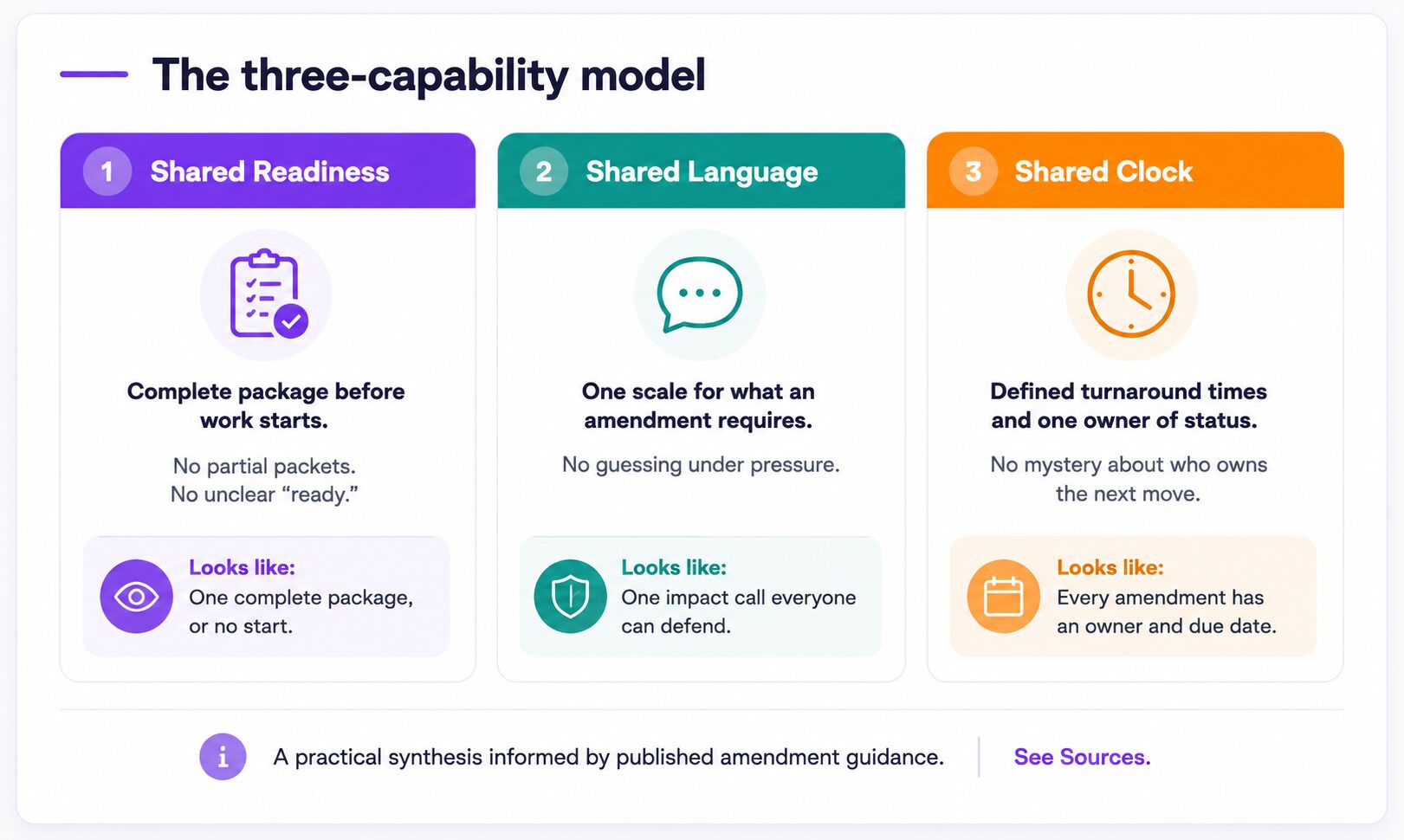
Shared Readiness: a definition of “ready,” not a trickle of documents
Readiness sounds obvious until you watch it fail. A site receives the protocol one day, the budget grid a few days later, the consent template the following week, and a “minor” lab manual change after that. Each arrival restarts a piece of the build. The fix is a complete, internally consistent amendment package with a coversheet that lists every changed document and version date, and an explicit “no change” where a document was not touched. The site does not start the affected work until the package is whole. That single rule removes most of the rework that quietly eats the calendar.
Shared Language: one scale everyone reads the same way
When a site, a sponsor, and an IRB each describe an amendment in their own terms, every handoff carries a translation cost. A shared impact scale removes it. The same change gets the same label, and the label tells everyone what may proceed. This is the capability a site can adopt entirely on its own, and it is where consent and version control go wrong most often, a theme we covered in Why Site IRB Submissions Fail.
Shared Clock: turnaround commitments and one owner of status
The last capability is the one most sites never formalize. Concrete windows work: acknowledge a complete package within 2 business days, return a feasibility read within 5, answer blocking questions within 5, and escalate when a window slips (AACI, 2026). Paired with a single named owner of amendment status, the question “can we start, or do we wait” stops bouncing between inboxes and gets a reliable answer.
Rank amendments by activation impact
The middle capability is the one most teams can adopt this week, with no one’s permission. The tool is a single ladder for an amendment’s impact, so “is this a big deal” stops being a fresh argument every time. Here is the simple version we use with sites.
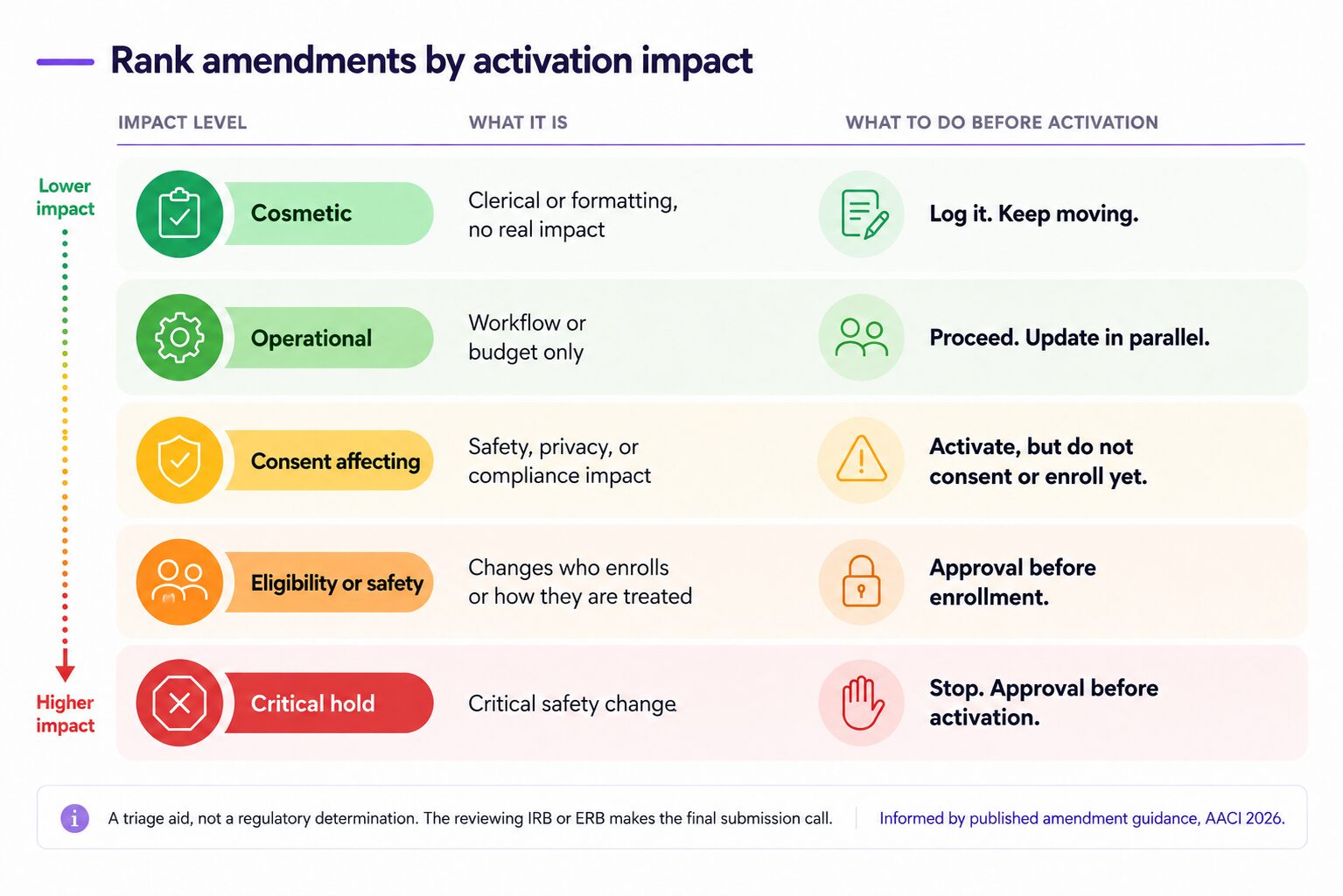
A site can adopt a ladder like this internally without waiting on partners. A shared scale turns a recurring judgment call into a fast, defensible one, and that changes how a startup queue moves.
Where this breaks at scale
Picture a startup coordinator on a Tuesday morning. Four studies sit open on her desk, all in startup. Study ABC-201 just landed its third protocol version, and she is no longer certain the consent she sent to the IRB last week is the current one. Study XYZ-105 has a budget amendment stuck in legal, and the sponsor is asking why activation has slipped. Two more are waiting on a feasibility read she has not had time to write.
Nothing on her desk is hard. Every item is a small, reasonable decision. The problem is that no single place tells her which version is live on which study, what is ready, and who owes the next move. So she spends the morning reconstructing that picture from email threads instead of clearing work. Multiply that one morning across a quarter, and you get the survey numbers.
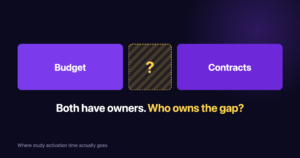
Here is the part no checklist solves. Readiness, language, and a clock are agreements. Agreements work on one study. They get harder to sustain the moment a site is running three, four, five startups at once, each with its own document versions, its own pending amendments, its own clock.
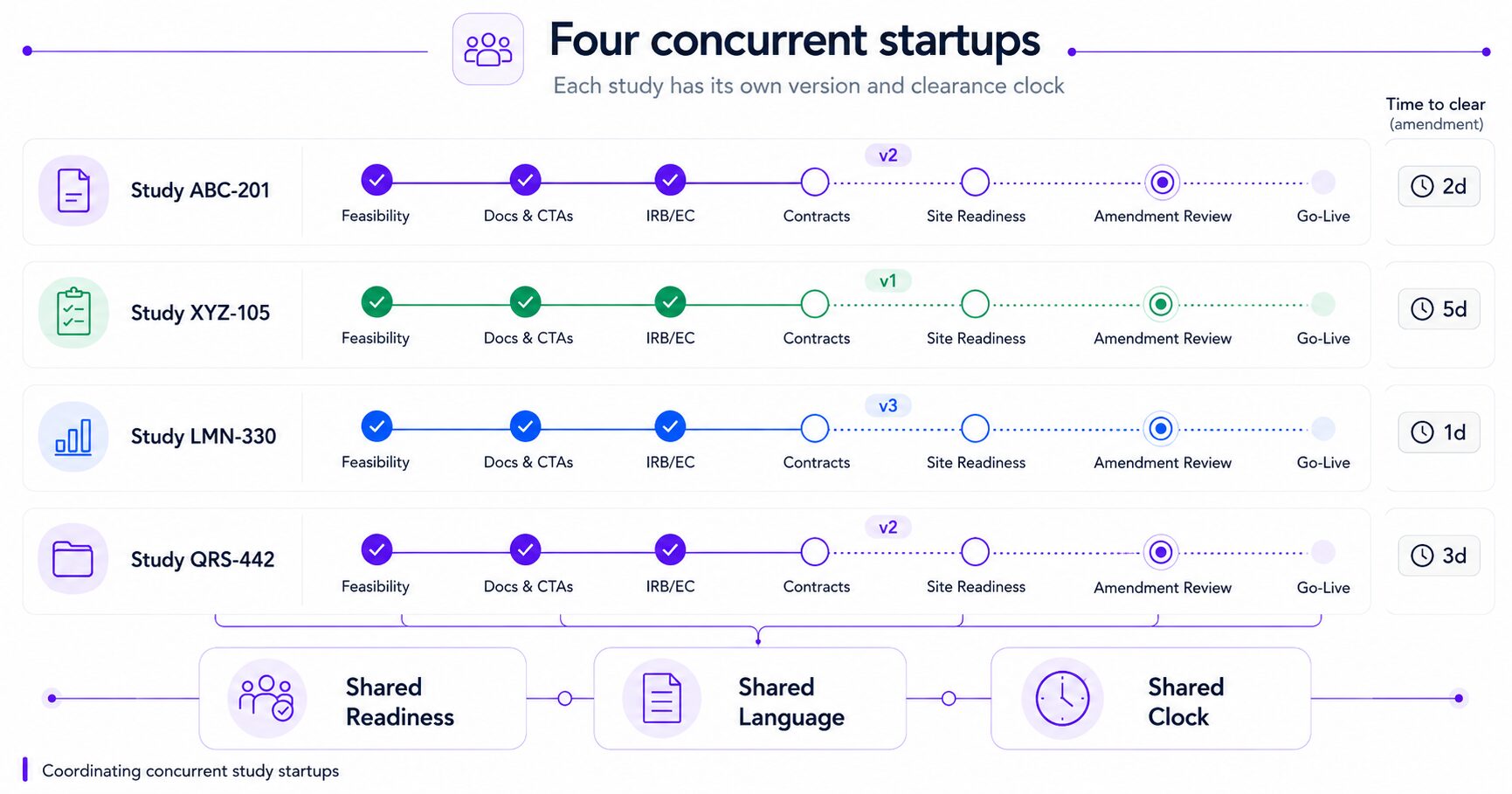
That is the real reason startup has become its own discipline. Not because the steps are hard, but because holding the state across many parallel startups is more than a spreadsheet or a calendar reminder can hold. The capabilities only stick when something holds the state for everyone: which version is live, what is ready, who owes the next move, and how long it has been waiting. It is also why a system built to run an open trial does not cover this work, the gap we walked through in Why Your CTMS Isn’t Built for Study Startup.
Put a rough number on it. On a Phase II or III trial, a single day of delay runs about $40,000 (Tufts CSDD). So two weeks of amendment churn, the low end of what most sites report, works out to roughly half a million dollars of delay cost on a single study by that benchmark, before a patient is ever enrolled. And money is the smaller cost. A site that opens two months behind its peers loses enrollment share on competitive trials, and sponsors remember which sites activate fast. The weeks lost before a trial opens quietly shape which trials a site is offered next.
A quick self-check
Can you answer these about your last startup?
- How many pre-activation amendments did it take?
- How many weeks did those amendments add to activation?
- At any given moment, did everyone know which protocol version was live?
- Was there a single person who owned amendment status?
- Could the team say, in one word, whether each amendment was minor or blocking?
If you cannot answer two or more of these, the delay is most likely already there. It is just unmeasured.
How a site digs out
The way out is not a transformation program, and our coordinator does not need to wait for one. It is three moves, in order, and the first needs no one’s permission.
First, she counts. For each startup, how many pre-activation amendments arrived, and how many weeks each one added. It takes an afternoon with old emails, and it changes the conversation, because most sites have never put a number on this. You cannot manage a delay you have never measured. Where to begin: the six startup metrics worth tracking.
Then, the team adopts one language. The impact ladder goes up on the wall, and “is this a big deal” stops being a fresh argument on every amendment. A junior coordinator can label a change cosmetic or critical and defend the call, while a named owner on each startup keeps a running list of which version is live. None of this needs a sponsor’s sign-off. It is simply how the site talks to itself.
Finally, the state stops living in her memory. The first two moves get a site surprisingly far, but they share a ceiling, the same one she hit on Tuesday morning. Across many concurrent startups, which version is live, what is ready, and who owes the next move is more than any one person or spreadsheet can hold reliably. The capabilities only stick when something holds that state for the whole team, visible to everyone at once.
You know it is working when the questions change. “Which version is live?” gives way to a few numbers anyone can see: amendments per startup, weeks added, time to clear by impact level, and how often a package arrives complete the first time. When those are the questions a site is asking, the discipline has taken hold.
How amendments should be handled
The three moves get a site surprisingly far, but doing this properly, across a whole portfolio, means letting a system carry what a person cannot. A good one does a specific job. Across every startup a site is running, it keeps one current answer, visible to everyone, to four questions: which protocol version is live, what is ready to work, who owns the next move, and how long it has been waiting. It carries the impact ladder, so a labeled amendment routes itself instead of waiting for a meeting. It holds the clock, so a slipped turnaround surfaces on its own. And it keeps a clean version trail, so the current document is never in question.
The real gains come from doing this once, shared. When the same readiness definition, the same impact labels, and the same clock are visible to the site and to its sponsors, CROs, and IRBs, the coordination cost drops on every side, not just inside the site. That is the difference between a site that survives amendments and one that barely notices them.
The takeaway
The white paper measured a delay. What it points to is a discipline coming into focus. Study startup is no longer a set of tasks one capable person can carry in their head across a few studies. It is a managed process with its own readiness, its own language, and its own clock. The sites that treat it that way will clear amendments while everyone else is still deciding whether the latest version is the one to build against.
If you want a number of your own, start with your last three startups. Count the amendments. Count the weeks. That single exercise tends to change the conversation.
Frequently asked questions
What is a pre-activation protocol amendment?
A pre-activation protocol amendment is a change to a study protocol that arrives after the startup package has gone to the site but before the site opens to accrual. Because the materials are already in motion, the change usually means rework rather than first-pass build.
Why do small amendments cause such large activation delays?
The amendment itself is often minor. The delay comes from everything that has to re-sync around it: consent versions, budgets, contracts, and system builds, across the site, the sponsor or CRO, and the IRB, with no shared owner of status. AACI found amendments most often add 4 to 6 weeks, and nearly 1 in 5 sites reported 10 weeks or more.
How should a site rank an amendment’s impact before activation?
Sort each amendment by what it actually requires, from cosmetic changes that affect no one, through operational and consent-affecting changes, up to critical safety changes that must hold activation until approved. A shared ladder lets a team make a fast, defensible call instead of debating each amendment from scratch. This practice is informed by published amendment guidance (AACI, 2026); the reviewing IRB or ERB makes the final submission determination.
Can a site activate a trial under a prior protocol version?
AACI recommends allowing it when later amendments are not safety critical. Where the reviewing IRB allows, a site may activate under a previously approved version and continue startup work while the amendment is under review. Final determination of IRB submission requirements rests with the reviewing IRB or ERB.
How can a site measure the impact of pre-activation amendments?
Start by counting, for each startup, how many pre-activation amendments arrived and how many weeks each one added to activation. Most sites have never tracked this, and the number alone usually reframes the conversation.
How is study startup different from a CTMS?
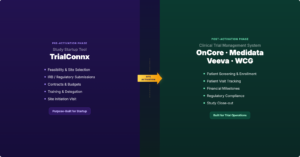
A CTMS is built to run an open trial: patient screening and enrollment, visits, and financial milestones. Study startup is the pre-activation work of getting a trial ready to open, and the AACI findings show it has its own readiness, language, and turnaround needs that systems built for the open trial were not designed to hold.
What three capabilities does a site need to manage amendments?
Three capabilities cover it: shared readiness (a clear definition of a complete package before work starts), shared language (one impact ladder everyone reads the same way), and a shared clock (defined turnaround times and a single owner of status). They distill the practical guidance emerging from cross-stakeholder work on amendments (AACI, 2026).
How many pre-activation amendments is normal for a site?
Most research sites handle 3 to 10 per month (AACI, 2026). Volume by itself is not the core problem. The delay comes from having no shared way to triage and track amendments across concurrent startups.
Who should own amendment status at a site?
Name one person per startup as the owner of amendment status, responsible for knowing which version is live and what is ready. A single named owner clears work faster than a committee, because there is never a question of whose move it is.
Does fixing amendment delays require new software?
Not to begin. Counting amendments and adopting a shared impact ladder with a named owner need no tools. The harder part, holding shared state across many concurrent startups, is where a dedicated study startup system helps, because email and spreadsheets do not hold shared state reliably.
Visual Summary
Get the impact ladder and the key numbers from this post in a swipeable slide deck. Download it or share it with your team.
Skip to PDF contentSources
- Association of American Cancer Institutes (AACI). Accelerating Clinical Trial Activation: a Collaborative Framework for Managing Pre-Activation Protocol Amendments. June 2026. PDF.
- Smith, Z. P., DiMasi, J. A., and Getz, K. A. (2024). New Estimates on the Cost of a Delay Day in Drug Development. Therapeutic Innovation and Regulatory Science, 58(5), 855-862. Source of the $40,000 per day cost-of-delay figure (authors affiliated with Tufts CSDD).
TrialConnx is a study startup platform that helps research sites manage activation work from pre-award through open to accrual, with the shared state these capabilities need. See how at trialconnx.com.