
The 30-Second Summary
Study startup turns a protocol into a live, recruiting study. It includes feasibility, site selection, contract & budget negotiation, IRB/EC approvals, and site initiation visits—ending at site activation. Teams using modern, parallelized workflows (AI site selection, virtual SIVs, e-regulatory) compress timelines from 6–8 months to roughly 8–12 weeks.
Clinical trial study startup is the operational process that takes you from protocol to activated sites: feasibility → selection → contracts → IRB/EC → SIV → activation. Skip or sequence these poorly and timelines stall. Imagine launching a rocket without blueprints, ground crew, or a launchpad—that’s a trial without proper startup. This is where theory becomes trained teams, approved documents, and green-lit enrollment.
The Evolution of Clinical Trial Startup

The Wild West Era (Pre-1950s)
Early research had little structure—no formal feasibility, training, or activation criteria.
- No standardized startup processes
- Minimal site vetting or readiness
- Ad-hoc selection and documentation
The Regulatory Renaissance (1960s-1990s)
Ethics frameworks and GCP formalized startup: feasibility, IRB/EC oversight, and SIVs became standard.
- Institutional Review Boards / Ethics Committees
- Formal feasibility assessments
- Mandated site initiation visits
The Digital Revolution (2000s-Present)
Cloud platforms enable parallel work; AI predicts site performance; virtual SIVs reduce cycle time.
- Electronic feasibility & site profiling
- Virtual/remote SIVs and training
- AI-assisted site selection & forecasting
The Modern Startup Gauntlet: Three Checkpoints

Feasibility: “Can we do this?”
Timeline: 4–8 weeks
Key Activities:
- Protocol complexity & visit schedule review
- Patient population & competing-study analysis
- Site capability & data infrastructure assessment
- Budgetary feasibility & resource planning
Readiness Signals:
- ≥80% confidence in enrollment
- 150% of required sites identified
- Budget variance < 10%
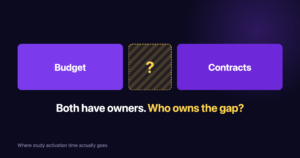
Contracts & IRB/EC: “Are we approved and funded?”
Timeline: Often the pacing item
- CTA & budget negotiation; payment terms
- IRB/EC initial approval & amendment handling
- CTMS/eBinder/eISF configuration
- Parallelization with training & logistics
Readiness Signals:
- Executed CTA & finalized budget
- Approval letters & regulatory packet complete
- Systems access provisioned (EDC, eTMF, CTMS)
Site Initiation & Activation: “Let’s enroll.”
Timeline: SIV 1–2 days per site; activation in days if prerequisites met
- Protocol deep-dive & GCP refresher
- Role-based system access & test records
- Drug/device, lab kits, logistics confirmed
- First-patient-in plan aligned
Activation Criteria:
- All staff trained & certified
- Supplies on-hand; systems operational
- Regulatory complete; screening window open
of studies miss startup timeline targets
average per-site initiation cost
of initiated sites never activate
The Hidden Challenges: What Nobody Talks About
⚠️ Red Flags in Startup
- “Paper-ready” vs. actually ready: Activated on paper, but no trained staff or supplies.
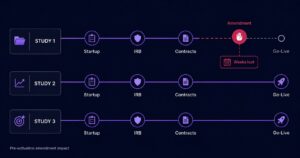
- IRB/EC re-review drag: A single amendment multiplies cycle time across sites.
- Budget black holes: Start-up costs exceed plan by 30–50% due to hidden tasks & rework.
- Turnover churn: ~40% coordinator turnover means repeated training & delays.
Equity Lens: Startup plans should reflect diverse sites and communities; otherwise enrollment lags and evidence isn’t representative.
Real-World Impact: A Tale of Two Startups

Traditional Startup
Timeline: ~8–10 months
- Email-based feasibility surveys
- Sequential contracts & IRB/EC
- In-person SIVs only
- Fragmented vendor hand-offs
Result: FPI at Month 9+
Modern Digital Startup
Timeline: ~3–4 months
- AI-assisted site matching & feasibility
- Contracts & IRB/EC run in parallel
- Virtual SIV with recorded modules
- Integrated startup platform & workflows
Result: FPI at Month 4
Success Story: Rare Disease Pediatric Study
By parallelizing contracts and IRB/EC, using AI site selection, and shifting to virtual SIVs, a sponsor cut startup from 10 to 4 months.
- 500+ sites profiled in 48 hours using AI-powered matching
- VR training modules for site staff on complex protocol procedures
- e-Reg binders & e-sign reduce regulatory document cycle time
- Pre-screen via EHR flags to identify eligible patients for immediate FPI

The Future Is Already Here: Startup Technology Stack

🤖 AI-Powered Startup Intelligence
- Predictive Analytics: forecast site performance & risk
- Digital Site Twins: model throughput & staffing
- Protocol Fit Scoring: suggest amendments pre-finalization
- Automated Risk Signals: surface bottlenecks in real time
🌐 Virtual Startup Capabilities
- Remote site assessments & qualification
- eReg/eISF with e-sign and audit trails
- Virtual SIVs + on-demand training modules
- Cloud collaboration for concurrent reviews
☁️ Integrated Startup Platforms
- Centralized site setup (people, systems, budgets)
- Pre-built SIV templates & role-based curricula
- Cross-stakeholder visibility & task orchestration
- Activation tracking from packet complete → green light

Frequently Asked Questions
How long should study startup really take?
With parallel workflows and modern tools, many studies complete startup in 8–12 weeks. Global/multi-vendor studies can take 16–20 weeks; the key is parallelizing contracts, IRB/EC, and training.
What predicts startup success the most?
Site readiness and engagement. Sites with experienced coordinators, confirmed logistics, and early systems access activate faster and enroll earlier.
Can AI really improve site selection?
Yes—AI analyzes historical performance, capacity, and local prevalence to predict throughput, reducing false starts and non-activations.
Where do contracts usually stall—and how do we fix it?
Budget escalators, payment terms, and indemnification. Solutions: pre-approved clause libraries, side-by-side budget compares, and early finance/legal alignment to cut weeks.
How much time does parallel IRB/EC save?
Running IRB/EC alongside training, logistics, and system provisioning commonly saves 3–6 weeks vs. sequential sequencing—especially for multi-site approvals.
What’s the cost of a delayed startup month?
It varies by program, but a month’s delay can mean six figures in operational costs plus lost revenue opportunity and patient access. Compressing startup is often the highest-ROI timeline win.
Make Startup Your Competitive Advantage
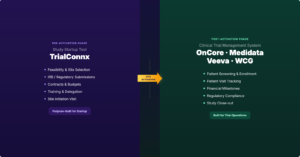
TrialConnx acts as your startup control tower—orchestrating feasibility, selection, contracts, IRB/EC, SIV, and activation with one real-time view.
The Path Forward: From Complexity to Clarity
Every day saved in startup is a day patients gain sooner. With parallelized processes, role-based training, and unified visibility, “Can we?” becomes “Let’s go.”

🚀 Start Faster. Enroll Smarter. Deliver Hope.
Related Reading:
References
- PMC Study on Clinical Trial Startup Delays (2020) – 86% of trials experience startup timeline delays
- Applied Clinical Trials Industry Research – Site initiation costs and activation rates
- FDA/ICH GCP Guidelines – Good Clinical Practice standards for site initiation and activation
- Clinical trial operations research – Digital transformation impact on startup timelines and costs