
How to Fix the Top 5 Study Startup Bottlenecks
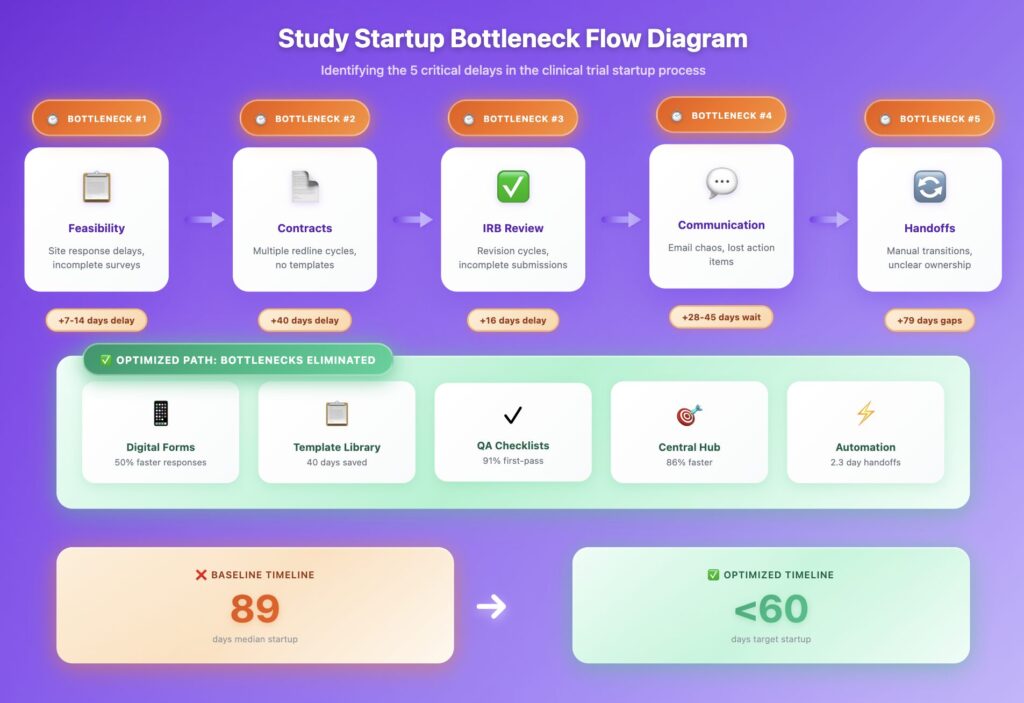
Top-performing sites activate studies in under 60 days while the median is 89 days. The difference? They’ve systematically eliminated five critical bottlenecks: feasibility delays, contract negotiations, IRB reviews, communication gaps, and task
handoffs. Here’s their playbook.
5 Study Startup Metrics That Actually Predict Delays

Stop measuring milestone dates. Start tracking the hidden bottlenecks that cause 80% of trials to miss enrollment timelines.
Clinical Trial Startup: From “Can We?” to “Let’s Go!”

Study startup turns a protocol into a live, recruiting study. It includes feasibility, site selection, contract & budget negotiation, IRB/EC approvals, and site initiation visits—ending at site activation. Teams using modern, parallelized workflows (AI site selection, virtual SIVs, e-regulatory) compress timelines from 6–8 months to roughly 8–12 weeks.
Are Spreadsheets Enough for Tracking Study Startup?

While spreadsheets work for simple tracking, clinical trial complexity demands more. See the latest data on efficiency gaps, hidden costs, and when to upgrade to purpose-built systems.
How to Cut Feasibility Response Times in Half: The Complete 2025 Guide

Top quartile sites respond to feasibility surveys in 3-5 days vs 15+ days for bottom quartile. Discover the proven two-phase approach that cuts response times in half while maintaining accuracy and sponsor satisfaction.
Clinical Trial Startup SOP Template (Free Download + Setup Tips)

See how a structured SOP transforms chaotic startup processes into sponsor-ready workflows that activate studies 30% faster.
Inside the Study Start-up Timeline: A View Most Research Teams Never See

If you’ve ever wondered why that promising clinical trial took six months to activate when everyone thought it would take six weeks, you’re not alone. The study start-up phase is clinical research’s best-kept secret—a complex orchestration of activities that happens largely behind the scenes, invisible to most research teams until delays start mounting. Most research […]
Scale Your Feasibility Response—Without Scaling Your Team

The Hidden Cost of Feasibility Overload If you’ve ever juggled six feasibility requests at once, you’re not alone—and you’re probably exhausted. For many clinical research teams, feasibility is deceptively labeled as “simple” paperwork. But behind each sponsor packet lies a web of deadlines, document versions, internal coordination, and unspoken stress. When multiple sponsors hit your […]