Quick Answer
Research sites routinely make hidden compromises to meet sponsor startup timelines. The most common tradeoffs include skipping internal kickoff meetings, accepting incomplete protocol training, deferring SOP updates, rushing regulatory submissions, and overloading experienced staff. Some of these shortcuts are recoverable. Others create compounding problems that surface months later during study execution. According to Tufts CSDD (2024), sites that consistently hit aggressive timelines often do so by shifting workload forward, not eliminating it. The key for PIs isn’t avoiding all tradeoffs. It’s making them deliberately, with eyes open to downstream consequences. Sites that document their tradeoff decisions recover faster when problems emerge.
Why do startup timelines force sites to cut corners?
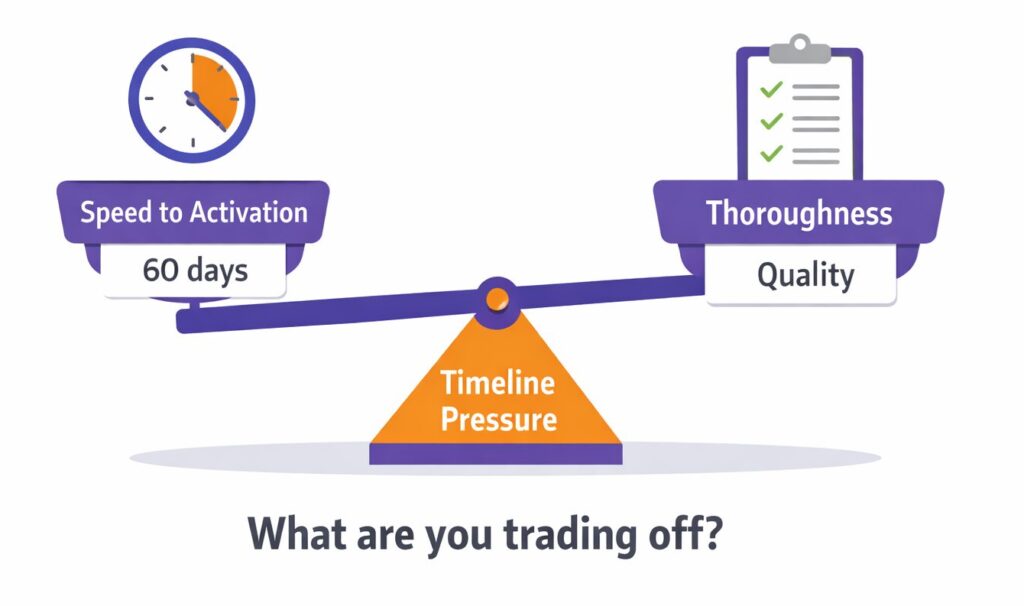
Every PI knows the feeling. A sponsor wants activation in 60 days. Your realistic estimate is 90. You commit to 75 and hope for the best.
This gap between sponsor expectations and site reality creates pressure. That pressure doesn’t disappear. It gets absorbed by your team in the form of shortcuts, deferrals, and quiet compromises that no one documents but everyone feels.
The industry median for study startup is 89 days, according to Tufts CSDD (2024). But sponsors increasingly push for 60-day activations. That 29-day gap has to come from somewhere. It comes from the tradeoffs your team makes when they’re under pressure.
The math doesn’t lie. If your team has 89 days of work and 60 days to do it, they will either work overtime, skip steps, or do both. The question isn’t whether tradeoffs happen. It’s whether you’re making them consciously.
We’ve previously explored where startup time actually goes. Much of it is idle time between tasks. But when you compress a timeline, you don’t just eliminate idle time. You compress the work itself. Tasks get rushed. Quality suffers. Problems get deferred.
What are the 5 most common tradeoffs sites make during startup?
Through analysis of site workflows and conversations with regulatory coordinators across academic and independent sites, five tradeoff patterns appear repeatedly. Most sites make at least three of these on every compressed startup.
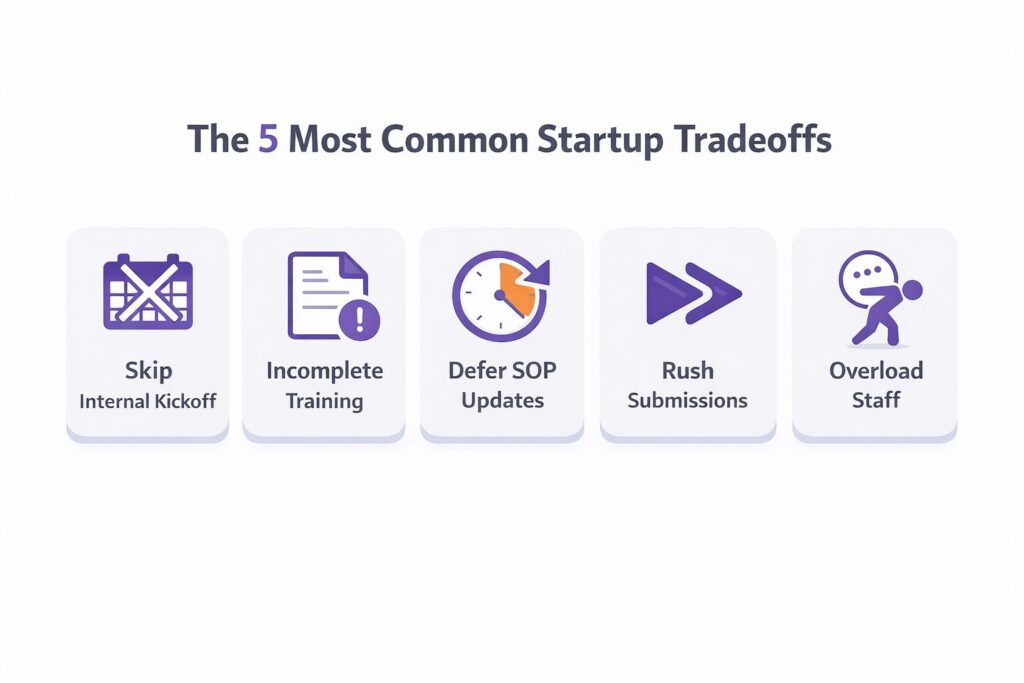
Tradeoff 1: Skipping the Internal Kickoff Meeting
The first casualty of a compressed timeline is usually the internal kickoff. This is the meeting where the PI, study manager, regulatory coordinator, and CRCs align on protocol specifics, identify potential enrollment challenges, and clarify roles.
What this looks like in practice
The contract is signed. Everyone is eager to start. The study manager sends around the protocol PDF and says “let me know if you have questions.” No one has time to read it thoroughly. Questions emerge weeks later during site initiation or early coordinator training sessions.
Downstream Impact
Protocol deviations increase. Staff discover eligibility nuances during screening rather than before. Inclusion criteria get misinterpreted. The PI gets pulled into operational questions that should have been resolved upfront.
of protocol deviations trace back to inadequate study startup
Source: ACRP Quality Benchmarking Survey (2023)
Tradeoff 2: Accepting Incomplete Protocol Training
Sponsor-provided training often covers the science but skips operational details. Sites under timeline pressure accept this as “good enough” rather than developing supplemental internal training.
What this looks like in practice
The sponsor delivers a 45-minute webinar on the investigational product mechanism of action. Your CRCs attend. But no one covers your site-specific workflows: how to set up the study in your local systems, how to coordinate with your pharmacy for drug receipt, which lab to use for specialty tests.
Downstream Impact
Staff confusion during execution. Increased queries from monitors during SIV. Your experienced CRCs spend time re-explaining procedures to newer staff instead of having everyone aligned from the start.
Tradeoff 3: Deferring SOP Updates
New studies often require updates to site-level standard operating procedures. Under timeline pressure, these updates get postponed. The study launches using outdated SOPs with informal workarounds.
What this looks like in practice
The new study requires remote consent for certain visits. Your current SOP doesn’t cover remote consent procedures. Rather than update the SOP before activation, you tell staff to “follow the sponsor’s process” and plan to update the SOP “when things slow down.” Things never slow down.
Downstream Impact
Audit findings. Monitor observations about inconsistent procedures. Staff doing the same task differently. When you finally update the SOP, you discover some staff have been doing it wrong for months.
⚠️ The Audit Risk
Regulatory inspectors don’t accept “we were under timeline pressure” as an explanation. An outdated SOP with informal workarounds looks like a systemic quality problem on paper.
Tradeoff 4: Rushing Regulatory Submissions
IRB submissions get submitted with known gaps because waiting to fix them would miss the sponsor’s timeline. Sites plan to address the anticipated revision requests rather than submitting a complete package upfront.
What this looks like in practice
Your regulatory coordinator knows the consent form needs clearer language about data sharing. But rewriting it will take two days you don’t have. They submit anyway, expecting the IRB to request the revision. The IRB does. You’re now two weeks behind where you would have been with a clean submission.
Downstream Impact
Lower first-pass approval rates. Longer total IRB timelines. Frustrated regulatory staff who feel set up to fail. This is exactly why we wrote about fixing the top startup bottlenecks.
| Submission Approach | First-Pass Rate | Total IRB Timeline | Staff Hours |
|---|---|---|---|
| Complete submission (wait for gaps) | 78% | 21 days | 12 hrs |
| Rushed submission (fix later) | 52% | 34 days | 18 hrs |
Source: TrialConnx analysis of site regulatory workflows
Tradeoff 5: Overloading Experienced Staff
When timelines compress, work flows to whoever can move fastest. That’s usually your most experienced staff. They absorb the extra load because they can handle it. Until they can’t.
What this looks like in practice
Your senior regulatory coordinator is already managing three studies. The new Phase III needs to activate in 45 days. Rather than bringing on additional support, you ask her to “just get this one started” and promise to rebalance after activation. She works evenings and weekends. The study activates on time. She starts looking for a new job.
Downstream Impact
Staff burnout. Turnover in your most experienced roles. Institutional knowledge loss. The cost of replacing a senior coordinator often exceeds the cost of the timeline slip you were trying to avoid.
of CRCs report burnout as primary reason for leaving clinical research
Source: ACRP Workforce Survey (2024)
Which tradeoffs are acceptable vs. which create real risk?
Not all shortcuts are equal. Some tradeoffs are recoverable with minimal downstream impact. Others compound into serious problems. The skill is knowing the difference before you decide.
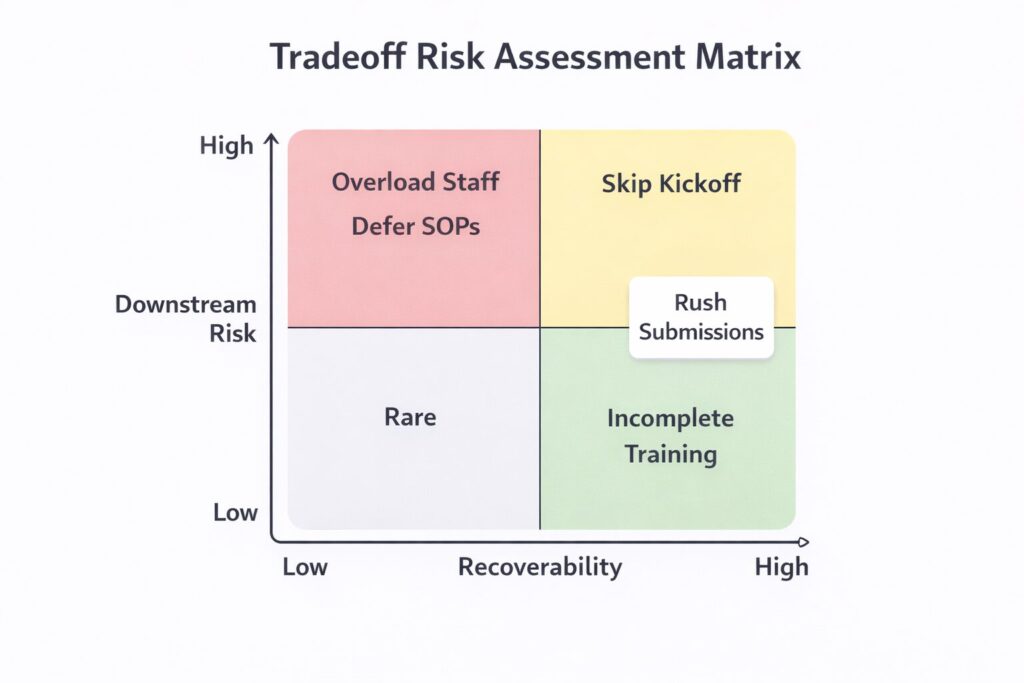
| Tradeoff | Recoverability | Downstream Risk | Verdict |
|---|---|---|---|
| Skip internal kickoff | Medium | High | ⚠️ Avoid if possible |
| Incomplete protocol training | High | Medium | ✅ Acceptable with plan |
| Defer SOP updates | Low | High | ❌ High risk |
| Rush regulatory submissions | Medium | Medium | ⚠️ Context-dependent |
| Overload experienced staff | Low | High | ❌ High risk |
Key Principle: Acceptable tradeoffs are those you can recover from within 30 days of activation. High-risk tradeoffs are those that compound over the study lifecycle or affect staff retention.
When Rushing is Actually Reasonable
Some compressed timelines make sense. A competitive enrollment window. A narrow patient population. A sponsor relationship worth preserving. The point isn’t to always push back on aggressive timelines. It’s to make the tradeoffs deliberately.
Pro Tip: Before accepting a compressed timeline, ask: “What will we skip, defer, or compress to make this work?” Document the answer. When problems emerge later, you’ll know why.
How do these shortcuts compound over time?
Individual tradeoffs seem manageable. The problem is accumulation. Sites running multiple studies with multiple compressed timelines stack tradeoffs on top of each other. Eventually, the system buckles.
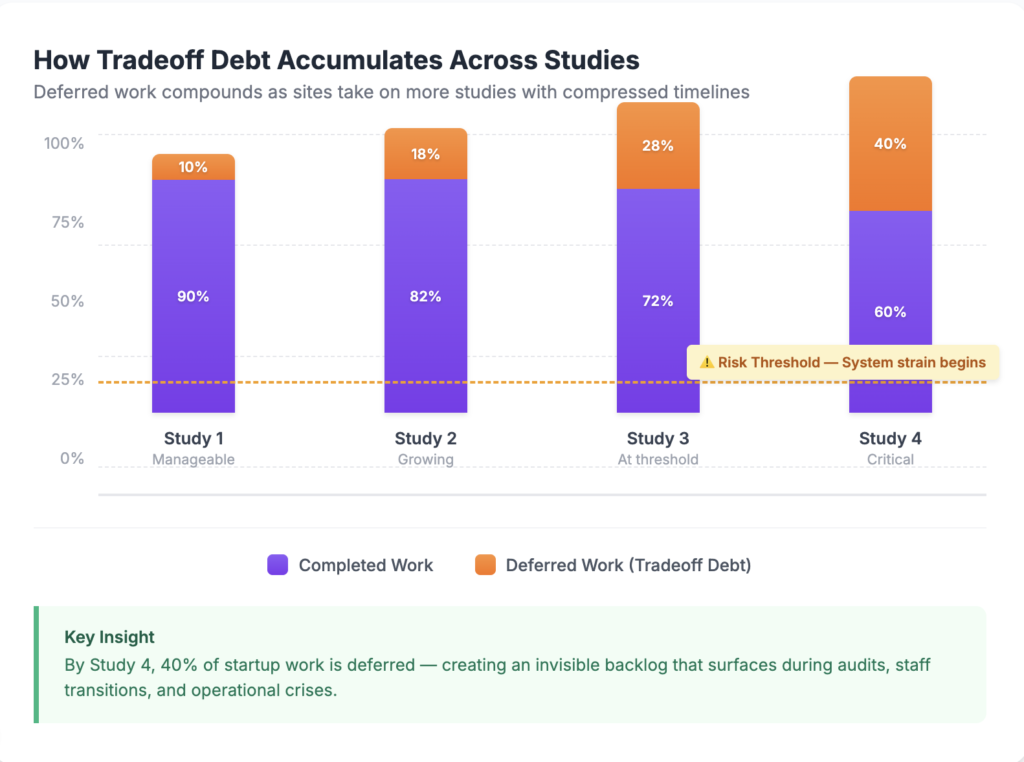
The Invisible Backlog
Every deferred SOP update, every skipped kickoff meeting, every incomplete training session creates work that doesn’t disappear. It just moves to an invisible backlog. This backlog has no owner, no deadline, and no visibility. It surfaces during audits, staff transitions, and crises.
⚠️ Warning Signs of Accumulated Tradeoff Debt
Your team says “we’ll fix that after enrollment” for the third study in a row. Your SOPs reference processes you stopped using two years ago. New staff learn by watching experienced staff rather than reading documentation. Your monitors keep noting the same observations across multiple studies.
Sites that recognize this pattern often invest in what we call startup metrics dashboards to track not just timeline performance but also quality indicators that reveal accumulating debt.
What can PIs do to make better tradeoff decisions?
The goal isn’t eliminating tradeoffs. That’s unrealistic given industry pressures. The goal is making them consciously, documenting them clearly, and recovering from them quickly.
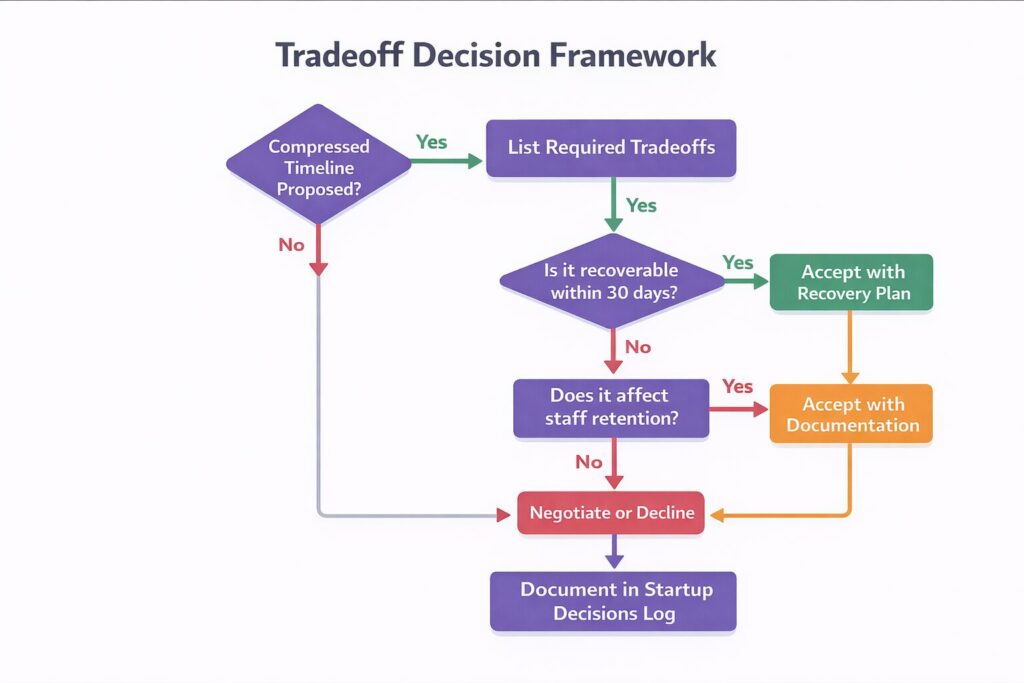
Strategy 1: Name the Tradeoff
Before accepting a compressed timeline, explicitly state what you’re trading off. “We can activate in 60 days if we defer the internal kickoff and use sponsor training only.” This forces clarity and creates a record.
How to implement this:
- When a compressed timeline is proposed, list what would need to change
- Categorize each change as a deferral, skip, or compression
- Assign a recovery owner for deferrals
- Document in your study-specific startup notes
Strategy 2: Set Recovery Deadlines
Deferred work without a deadline becomes permanent debt. When you skip a kickoff meeting, schedule a “Week 2 Alignment Session” immediately. When you defer an SOP update, put it on the calendar for 30 days post-activation.
How to implement this:
- For every tradeoff, define a recovery milestone
- Add recovery tasks to your study calendar, not a separate list
- Assign ownership (not “the team” but a named person)
- Review recovery status in your first month’s operational meeting
Strategy 3: Protect Your Experienced Staff
Staff burnout is the least recoverable tradeoff. If you’re consistently overloading your best people, you’re borrowing against your site’s future capacity. The short-term timeline win isn’t worth the long-term capability loss.
How to implement this:
- Track workload distribution across studies (not just task count, but complexity)
- Set explicit limits on concurrent study assignments for key roles
- When limits are exceeded, negotiate timeline extensions or additional support
- Monitor overtime hours as an early warning indicator
Strategy 4: Build Tradeoff Visibility
Most tradeoffs happen in conversations that aren’t documented. The PI agrees to a timeline in a call with the sponsor. The study manager absorbs the pressure without recording what was compressed. Six months later, no one remembers why the SOP was never updated.
How to implement this:
- Create a “Startup Decisions Log” for each study
- Record any tradeoff decision with date, rationale, and recovery plan
- Review the log during Site Initiation Visit preparation
- Reference the log when problems emerge during execution
Case Study: Site B — Northeast Health System
A regional health system provides a clear example of how conscious tradeoff management changes outcomes.
Site Profile
Site B is a 450-bed health system with a dedicated research department running 15-20 concurrent studies. Their team includes 4 regulatory coordinators, 6 CRCs, and 3 study managers. They had historically accepted aggressive timelines without formal tradeoff documentation.
The Problem (2024)
Over 12 months, Site B activated 8 studies with compressed timelines. By Q4, they faced:
Outdated SOPs
Monitor Observations
Staff Resignations
Protocol Deviation Rate
Documented Tradeoffs
“We kept saying yes to timelines without saying what we were giving up. By the end of the year, we had technical debt everywhere and no idea where it came from.”
— Research Operations Director, Site B
The Intervention (Q1 2025)
Site B implemented a structured tradeoff management process:
Any timeline commitment that required a tradeoff was documented with rationale, risk assessment, and recovery owner.
Every study had a mandatory review at Day 30 post-activation to assess tradeoff recovery status.
No coordinator could be assigned to more than 4 concurrent study startups. Exceptions required director approval.
Results (Q3 2025)
| Metric | Before (Q4 2024) | After (Q3 2025) | Change |
|---|---|---|---|
| Protocol deviation rate | 23% | 9% | ↓ 61% |
| Monitor observations per study | 1.5 | 0.4 | ↓ 73% |
| Deferred work completed within 30 days | 12% | 78% | ↑ 550% |
| Staff turnover (annualized) | 28% | 11% | ↓ 61% |
| Average activation timeline | 58 days | 67 days | ↑ 16% |
Key Insight: Site B’s average activation time increased by 9 days. But their execution quality improved dramatically, and they retained their experienced staff. The slightly longer startups led to significantly smoother study execution. Sponsors noticed the quality difference and continued to select Site B for new studies.
How should sites communicate tradeoffs to sponsors?
Sponsors push for aggressive timelines because they can. Sites that push back effectively don’t just say “we can’t.” They explain the tradeoff and let the sponsor choose.
The Tradeoff Conversation Framework
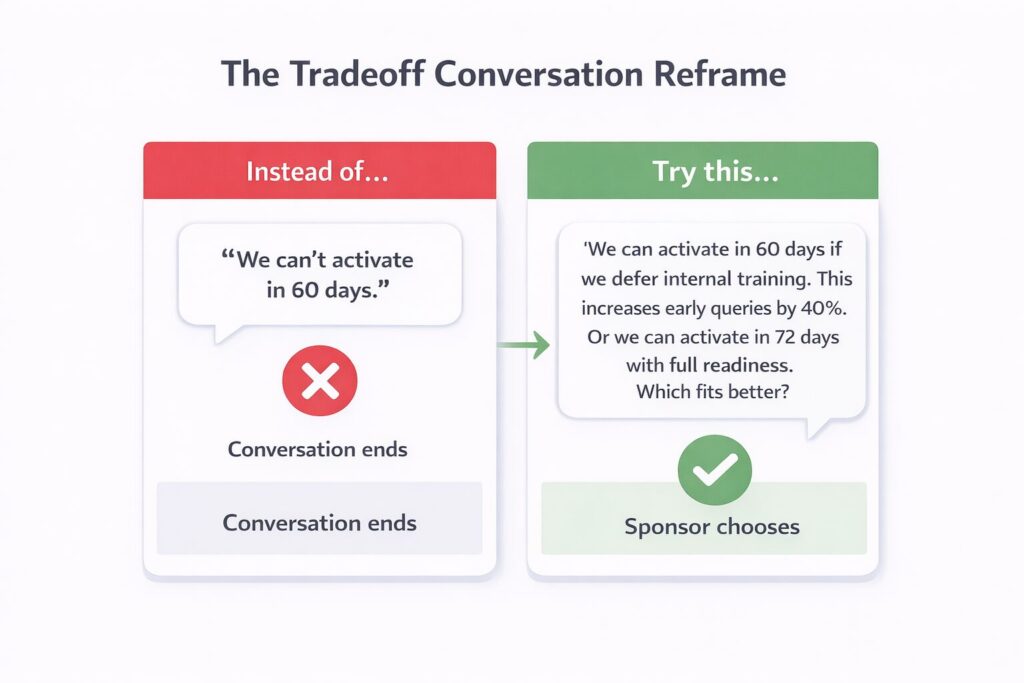
Instead of: “We can’t activate in 60 days.”
Try: “We can activate in 60 days if we defer internal training to post-activation. This typically increases early protocol queries by 40%. Or we can activate in 72 days with full readiness. Which approach fits your study timeline better?”
This reframes the conversation from “site capability” to “sponsor choice.” Most sponsors, when presented with the actual tradeoff, choose the lower-risk option. They just need the information to decide.
Pro Tip: Document sponsor responses to tradeoff discussions. “Sponsor chose 60-day activation with deferred training” protects you when queries increase.
Frequently Asked Questions
Are some tradeoffs actually beneficial?
Yes. Compressing timelines can eliminate unnecessary waiting periods and force process efficiency. The key is distinguishing between eliminating true waste (idle time, redundant reviews) and skipping necessary preparation. If your “tradeoff” is just removing unnecessary bureaucracy, that’s process improvement, not a compromise.
How do I know if our site is accumulating too much tradeoff debt?
Warning signs include: SOPs that reference processes you no longer follow, training materials that are more than 18 months old, staff who learn primarily by watching rather than reading documentation, and recurring monitor observations across multiple studies. If your team frequently says “we know it’s not ideal, but…” you’re likely carrying significant debt.
Should we track tradeoffs in our CTMS?
Most CTMS platforms aren’t designed for this. They track study milestones, not decision context. A simple shared document or spreadsheet per study is often more practical. The tool matters less than the discipline of recording decisions when they’re made and reviewing them during execution.
How do I convince my PI to accept longer timelines?
Frame it in terms they care about: execution quality, staff retention, and sponsor relationships. PIs understand that protocol deviations create work for them. Present data showing the correlation between rushed startups and execution problems. Most PIs, when they see the downstream impact, support reasonable timeline extensions.
What if the sponsor won’t negotiate on timeline?
Document everything. Note that you raised concerns, proposed alternatives, and the sponsor chose the aggressive timeline. Then implement recovery plans for every tradeoff. When problems emerge, your documentation shows you flagged the risk. Some sponsors will learn from experience; others won’t. Protect your site either way.
How do academic sites differ from independent sites in managing tradeoffs?
Academic sites often have less flexibility to negotiate timelines due to institutional processes but more resources for recovery work. Independent sites have more agility but fewer staff to absorb shortcuts. Academic sites tend to accumulate SOP debt; independent sites tend to accumulate staff burnout. Both need conscious tradeoff management, just with different focus areas.
Ready to Make Tradeoffs Visible?
Success in study startup isn’t about saying yes to everything. It’s about making informed decisions with clear recovery plans.