Quick Answer
IRB review times vary widely across institutions – and revision cycles can add weeks to your timeline. FDA’s FY 2023 inspections consistently cite the same issues: failure to follow the investigational plan, inadequate records, informed consent problems, and safety reporting delays. Common ICF errors include missing signatures, outdated form versions, and failure to re-consent after protocol changes. Sites that implement pre-submission QA protocols can significantly reduce revision cycles and cut weeks from their IRB timelines. The difference isn’t working harder. It’s catching predictable errors before they reach the IRB reviewer’s desk.
What are the most common IRB revision requests sites receive?
IRB revisions feel random until you track them. But FDA inspection data and industry experience reveal clear patterns in what goes wrong—and most issues fall into predictable categories.
What FDA Inspections Reveal (FY 2023)
FDA’s Bioresearch Monitoring (BIMO) program conducted 1,073 inspections in FY 2023, including 681 clinical investigator inspections. The most common violations cited:
| Violation Category | Description |
|---|---|
| Failure to follow investigational plan | Not adhering to the approved protocol |
| Inadequate records | Incomplete or inaccurate case histories and study documentation |
| Informed consent issues | Problems with consent process or documentation |
| Investigational product accountability | Inadequate control or tracking of study drugs/devices |
| Safety reporting failures | Late or missing adverse event reports |
Source: FDA BIMO FY 2023 Inspection Data
The Informed Consent Problem
Informed consent issues consistently appear in FDA findings. In 2024, 4 of 7 Warning Letters issued related to IRB activities—including consent form compliance failures. Common ICF errors that trigger revisions:
| ICF Issue | Why It Happens |
|---|---|
| Missing or incomplete signatures | Rush to enroll, inadequate verification process |
| Wrong version used | Protocol amendments not tracked, outdated forms in circulation |
| Re-consent not obtained | Changes to protocol not communicated to already-enrolled subjects |
| Missing required elements | Consent form doesn’t include all elements required by 21 CFR 50.25 |
| Readability issues | Language above 8th-grade level, excessive jargon |
FDA Warning Letter Patterns (2024)
Recent FDA Warning Letters to clinical investigators and IRBs consistently cite:
The most frequently cited violation
Including forms that don’t comply with Part 50 requirements
Missing documentation of key study activities
Late reporting of adverse events and unanticipated problems
Source: FDA BIMO Trends 2023-2024
Key Insight: The sites with the highest first-pass rates aren’t smarter. They’re more systematic. They’ve built prevention into their workflow instead of relying on individual vigilance.
Every one of these mistakes is preventable with the right pre-submission process. That’s why top-performing sites invest in QA protocols before submission rather than rework cycles after rejection. For a complete view of startup bottlenecks, see How to Fix the Top 5 Study Startup Bottlenecks.
What does IRB first-pass approval rate actually measure?
First-pass approval rate is the percentage of IRB submissions approved without any revision requests. It’s the clearest signal of regulatory submission quality.
First-Pass Approval Rate = (Submissions approved without revisions ÷ Total submissions) × 100
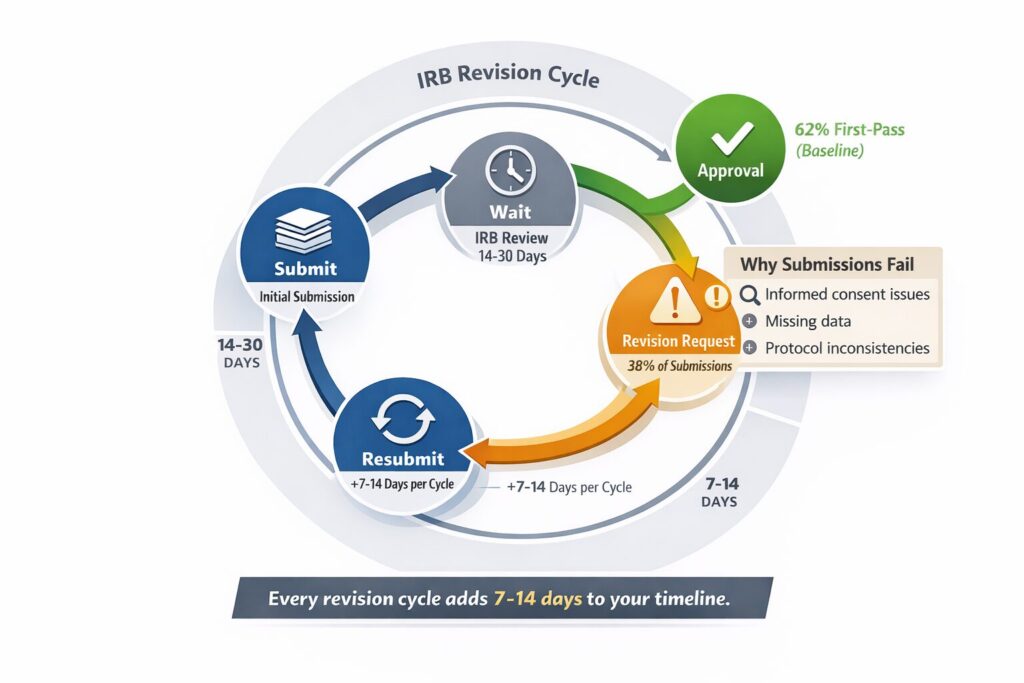
This metric matters because every revision request adds time. A single revision cycle typically adds 7-14 days to your timeline. Multiple cycles can add 30+ days.
IRB Timeline Benchmarks
IRB review timelines vary significantly based on institution, study complexity, and review type:
| Review Type | Typical Timeline | Notes |
|---|---|---|
| Expedited review | 2-4 weeks | Minimal risk studies, amendments |
| Full board review | 4-8 weeks | Greater than minimal risk, vulnerable populations |
| Revision cycle | +1-2 weeks each | Each revision request adds to total timeline |
The real timeline killer isn’t the initial review—it’s revision cycles. A clean submission that goes through in 4 weeks beats a rushed submission that takes 3 weeks but triggers two revision cycles.
Suggested Performance Targets
Based on industry patterns, sites can use these targets to assess their regulatory submission quality:
| Performance Level | First-Pass Rate | Interpretation |
|---|---|---|
| Strong | 75%+ | Process is working; focus on edge cases |
| Developing | 60-74% | Systematic issues likely; audit recent rejections |
| Needs Attention | <60% | Process gaps present; implement QA protocols |
Note: These are suggested internal targets. Industry-wide first-pass benchmarks are not publicly available.
What Your Rate Tells You
Below 60%
You’re likely skipping QA steps, working without checklists, or rushing submissions to meet sponsor pressure. Each rejection compounds timeline damage.
60-74%
You have the basics in place but gaps remain. Common culprits: inconsistent checklist use, no second-reviewer requirement, or IRB-specific requirements being missed.
75%+
Your process is sound. Focus on mining revision history for edge cases and building institutional knowledge about your specific IRB’s preferences.
Pro Tip: Start tracking first-pass rate this month. Even without process changes, measurement alone typically improves performance by 10-15% through increased awareness. This aligns with metrics that actually predict delays.
How do top-performing sites minimize revision cycles?
Sites that consistently avoid revision cycles aren’t working harder. They’re working differently. Four strategies separate top performers from the pack.
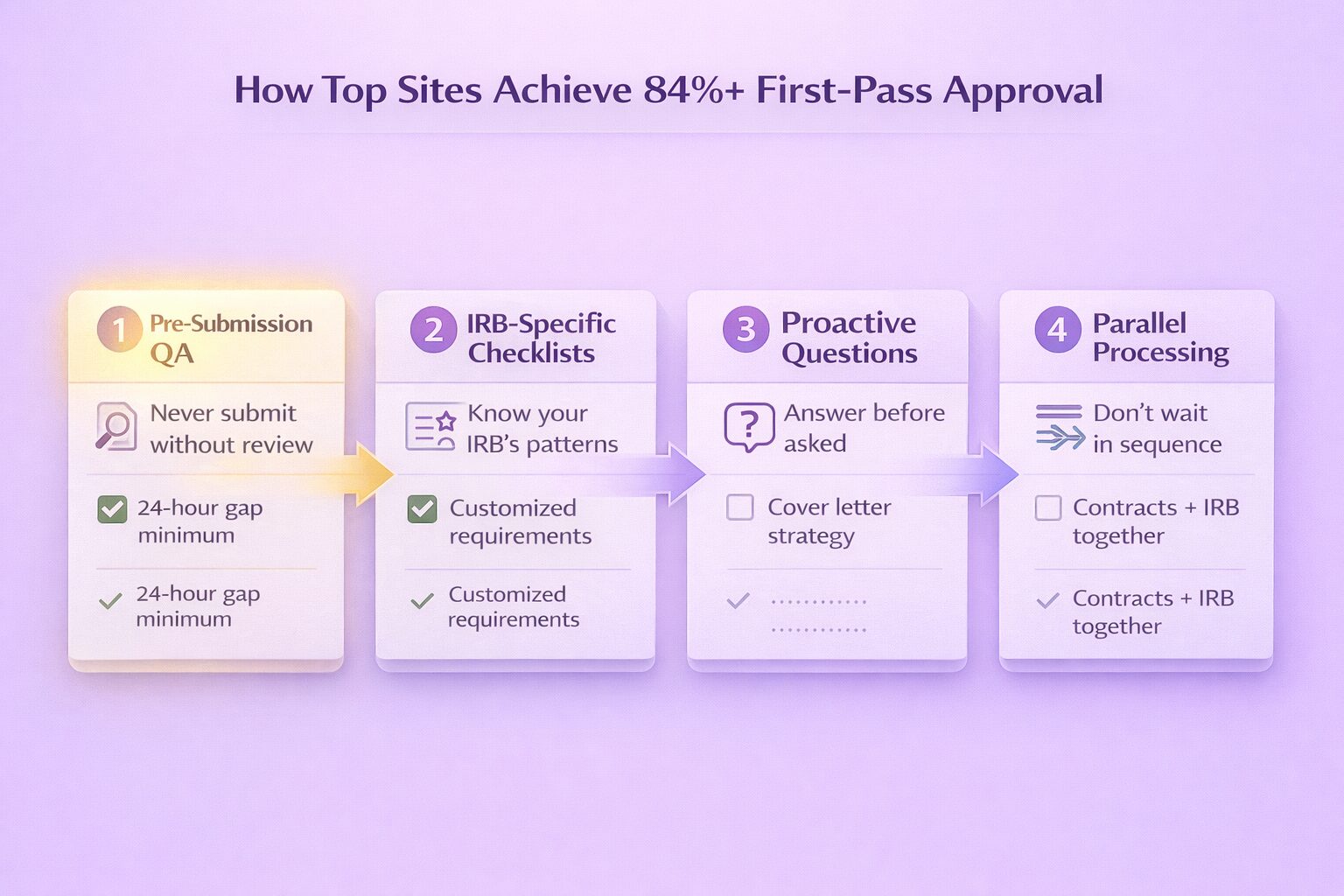
Strategy 1: Pre-Submission QA Protocol
Top sites never submit without a dedicated QA step. The regulatory coordinator who prepared the submission is never the final reviewer. Fresh eyes catch what familiarity misses.
How to implement this:
- Require minimum 24-hour gap between preparation and QA review
- Use a different team member for QA whenever possible
- Create a standard QA checklist (see next section)
- Document QA completion with signature and date
Strategy 2: IRB-Specific Checklists
Generic checklists miss what specific IRBs care about. High-performing sites maintain customized checklists for each IRB they work with, built from that IRB’s actual revision history.
How to implement this:
- Audit last 10 submissions to each IRB
- Identify that IRB’s most common revision requests
- Add IRB-specific items to your standard checklist
- Update quarterly based on new patterns
Strategy 3: Proactive Question Anticipation
Instead of waiting for IRB questions, top sites answer predictable questions in their cover letters. This demonstrates thoroughness and prevents back-and-forth delays.
Common Questions to Address Proactively:
- Why is the proposed compensation appropriate (not coercive)?
- How will you ensure consent is truly voluntary for vulnerable populations?
- What is your plan if a subject becomes ineligible after consent?
- How will remote/decentralized procedures maintain data integrity?
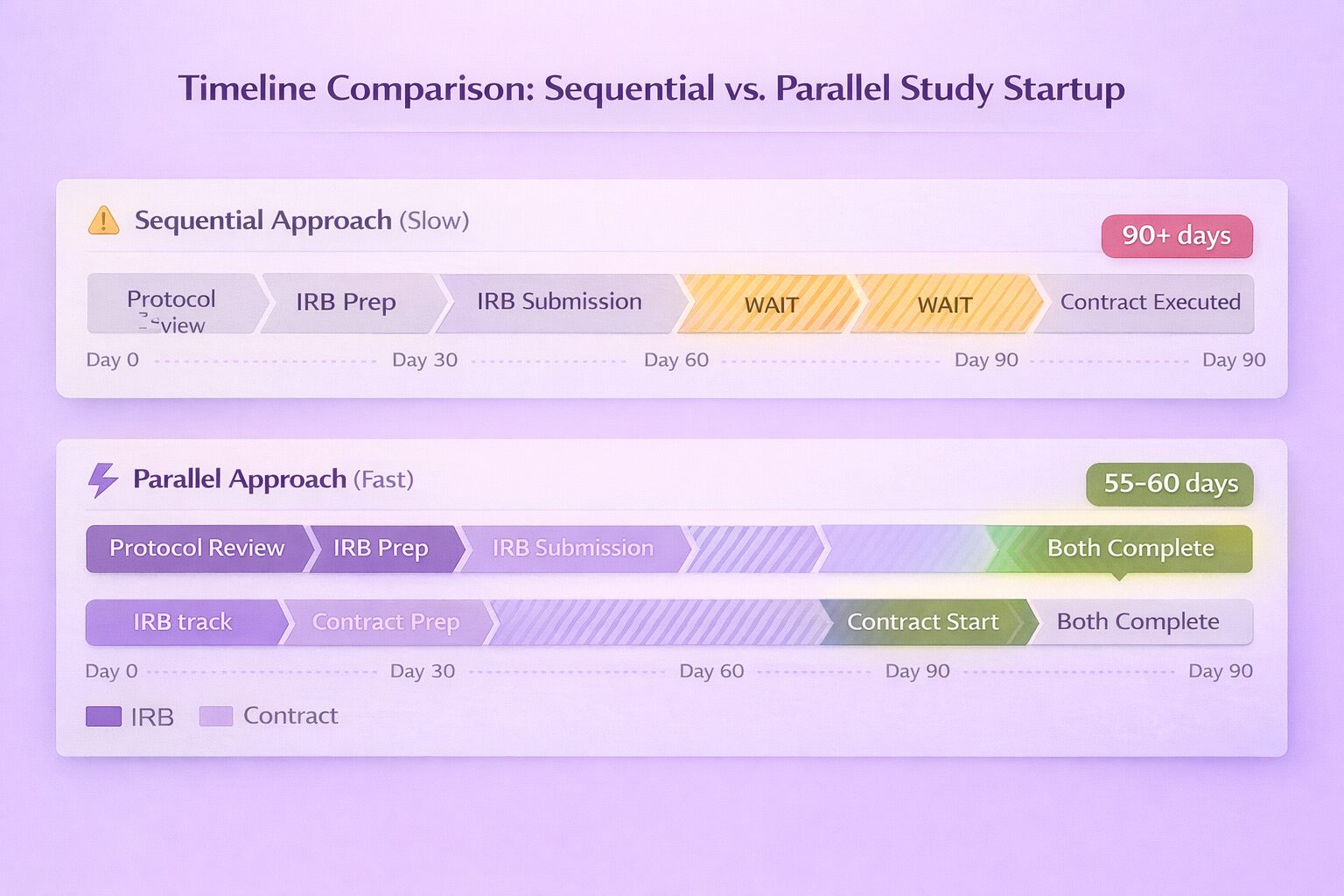
Strategy 4: Parallel Processing
Sequential workflows kill timelines. While waiting for one document, prepare the next. Top sites run regulatory, contracting, and site preparation in parallel rather than series.
For a complete view of where startup time goes, see Inside the Study Start-up Timeline.
Illustrative Example: What QA Implementation Can Achieve
The following is a composite example based on industry patterns and realistic improvement trajectories. It illustrates the type of gains sites can expect when implementing systematic QA protocols.
Site Profile
Mid-size academic medical center running 20+ concurrent studies. Implemented all four strategies over a 90-day period.
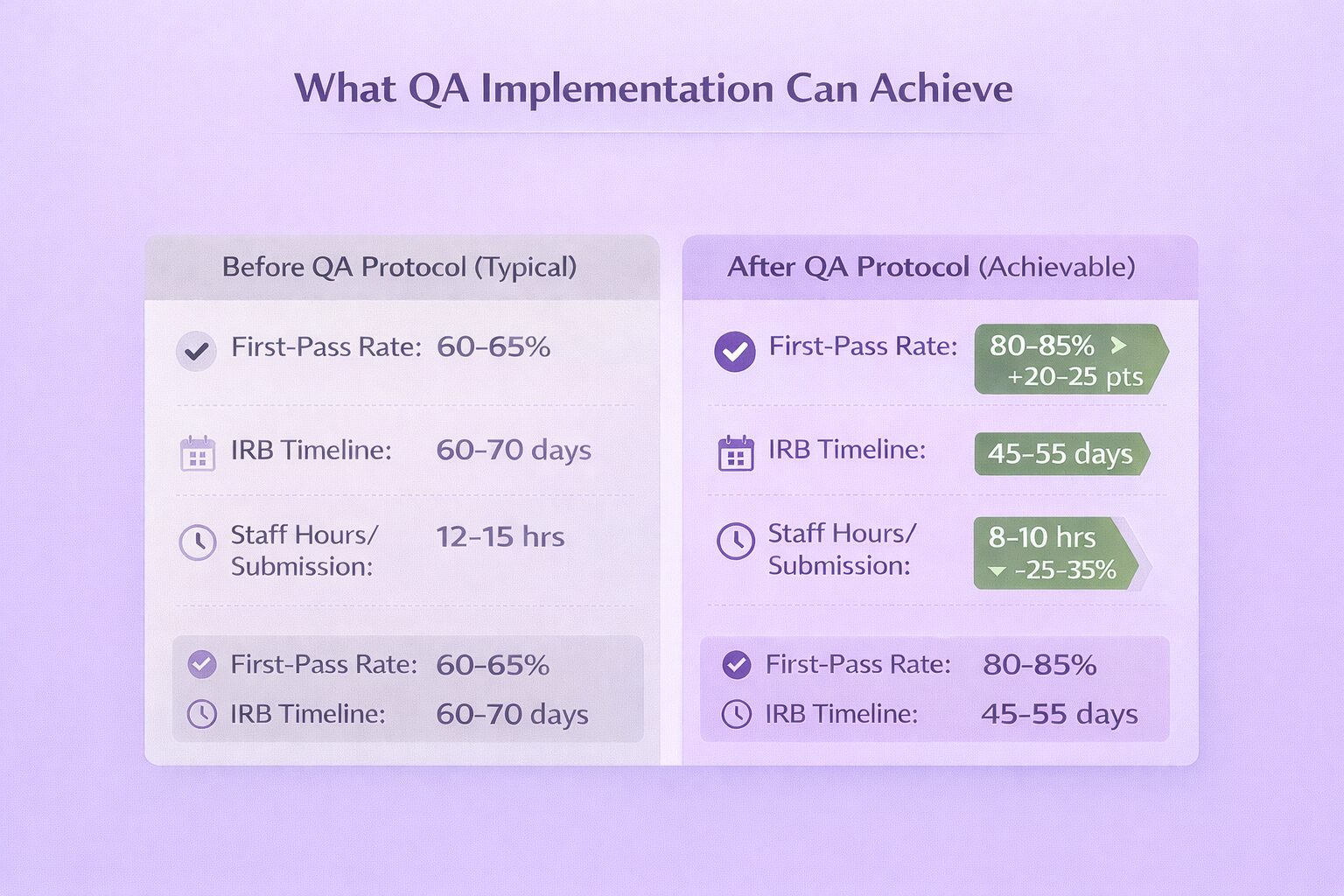
| Metric | Before (Typical) | After (Achievable) | Potential Improvement |
|---|---|---|---|
| First-pass approval rate | 60-65% | 80-85% | +20-25 points |
| Average IRB timeline | 60-70 days | 45-55 days | -15-20 days |
| Staff hours per submission | 12-15 hrs | 8-10 hrs | -25-35% |
Context: The AACI 2024 survey found that only 9% of sites meet a 90-day activation target for industry studies, while nearly 60% meet it for NCI-sponsored studies. This gap suggests significant room for process improvement at most sites.
Key Insight: The time invested in QA (about 2 hours per submission) typically saves more time in avoided rework and shorter revision cycles. Prevention beats reaction.
What should a pre-submission QA checklist include?
A comprehensive QA checklist has three components: document completeness, internal consistency, and IRB-specific requirements.
Document Completeness Checklist (10 Items)
- Protocol (current version, signed and dated)
- Informed Consent Form (all required elements per 21 CFR 50.25)
- HIPAA Authorization (if separate from ICF)
- Investigator’s Brochure (current version)
- PI CV and medical license (unexpired)
- Human subjects training certificates (current for PI and all study staff)
- Conflict of interest disclosures (all investigators)
- Recruitment materials (ads, flyers, scripts)
- Data security/privacy plan
- Site-specific procedures (if required by IRB)
Consistency Checks (5 Items)
- ICF visit schedule matches protocol visit schedule
- ICF risk descriptions match protocol safety section
- Recruitment materials match approved eligibility criteria
- PI name and credentials consistent across all documents
- Study title consistent across all documents
IRB-Specific Requirements
Every IRB has quirks. Build a section for each IRB you work with regularly:
Example: [Your Local IRB]
- Cover letter addresses compensation justification
- Consent form uses 8th-grade reading level
- Vulnerable population section uses IRB’s specific template language
- Data security plan references institution-approved storage locations
- Recruitment materials include required disclosure about voluntary participation
Pro Tip: After every revision request, add the issue to your IRB-specific checklist. Your checklist should grow over time as you learn each IRB’s patterns. For standardizing these processes, see our Clinical Trial Startup SOP Template.
How can sites prepare for predictable IRB questions?
IRBs ask the same questions repeatedly. High-performing sites don’t just answer these questions—they anticipate and address them before they’re asked.
Pull the last 20 IRB submissions across all your studies. Categorize every revision request. You’ll find patterns: compensation questions, vulnerable population concerns, AE reporting clarifications, data security questions for remote procedures.
For each common question category, develop template language you can customize for each study. Example: “Subject compensation of $[X] per visit is based on time (approximately [X] hours), travel, and inconvenience. This amount is consistent with local market rates…”
Don’t wait for the IRB to ask. Your cover letter should pre-address likely concerns: “We anticipate the following may require additional context: Compensation (see Attachment B), Vulnerable Populations (Protocol Section X), Remote Procedures (detailed in Appendix).”
Different IRBs have different cultures: some want exhaustive detail, others prefer brevity; some prioritize consent readability, others focus on protocol compliance. Track which approaches succeed with which IRB.
What metrics should regulatory coordinators track?
Tracking the right metrics transforms regulatory performance from reactive to proactive. Focus on both leading indicators (predict problems) and lagging indicators (measure outcomes).
Leading Indicators (Track Weekly)
These predict future problems before they materialize:
| Metric | Target | Warning Sign |
|---|---|---|
| QA checklist completion rate | 100% | <90% indicates process skips |
| Days in pre-submission review | 2-3 days | >5 days suggests bottleneck |
| Open revision requests | <5 | >10 indicates backlog |
| Submissions missing documents | 0 | Any indicates process gap |
Lagging Indicators (Track Monthly)
These measure actual outcomes:
| Metric | Target | Context |
|---|---|---|
| First-pass approval rate | 75%+ | Track your own baseline first |
| Average days to approval | <45 days | Industry range: 13-116 days |
| Revision cycles per submission | <1.0 | Each cycle adds 7-14 days |
| Time from revision to resubmission | <5 days | Minimize internal delays |
Note: Industry-wide benchmarks for first-pass rates are not publicly available. Focus on improving your own baseline.
For more on building effective dashboards, see The Minimal Viable Study Startup Dashboard.
Pro Tip: Track metrics at the individual level (constructively, not punitively). This identifies who may need additional training or support, and who has best practices worth sharing.
Stakeholder Takeaways
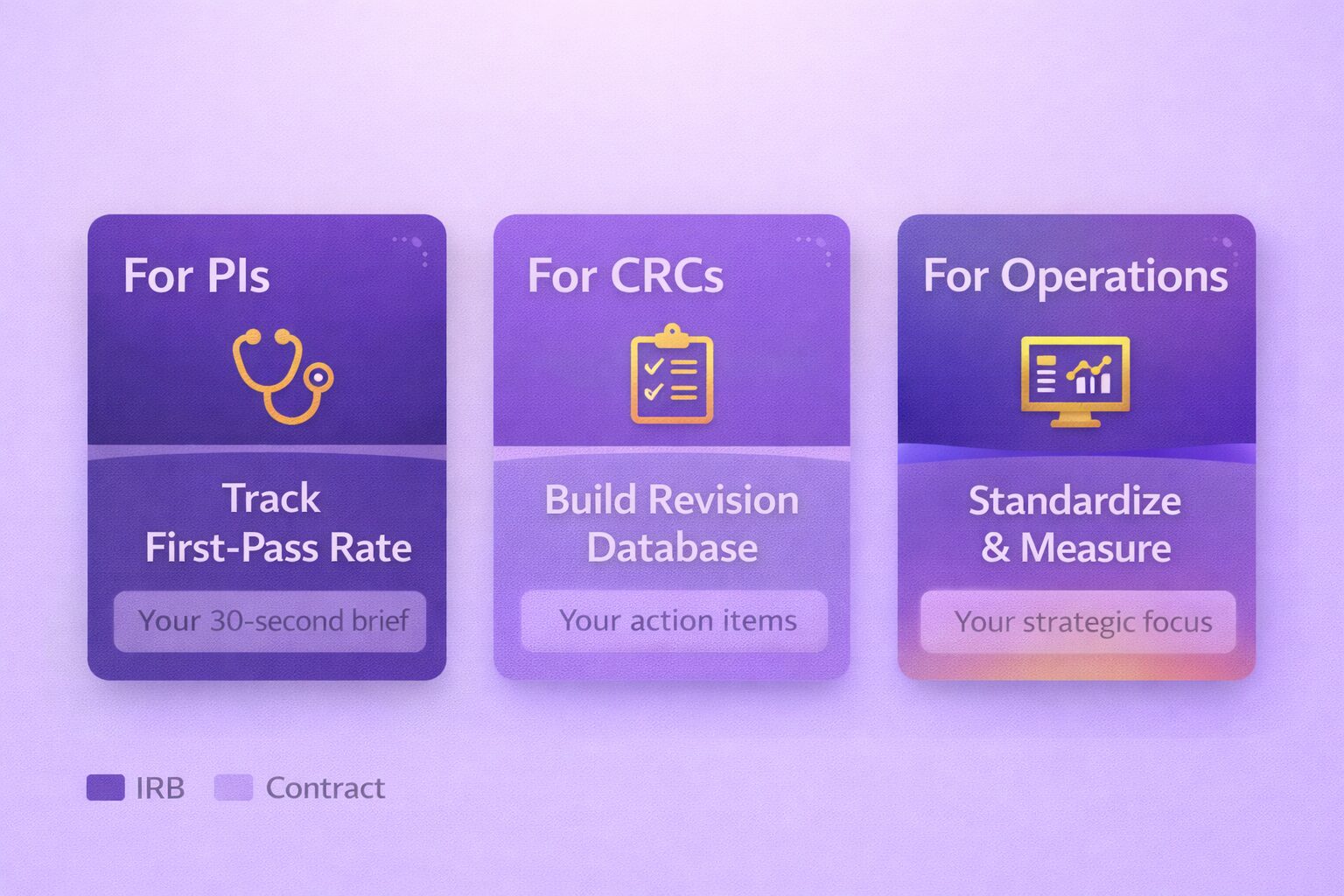
Your 30-Second Brief
Ask your regulatory coordinator: “What’s our first-pass rate?” If they don’t know, that’s the problem. Empower them with time for QA—rushing submissions costs more time than it saves. The difference between 62% and 84% first-pass is 16 days per study.
Your Action Items
Build a revision history database—every revision is a lesson. Never be your own final reviewer. Create IRB-specific checklists. Address predictable questions in cover letters. Two hours of QA saves 10+ hours of rework.
Your Strategic Focus
Standardize QA protocols across all studies. Track first-pass rate by coordinator. Invest in IRB-specific knowledge capture. Compare performance using industry benchmarks and understand what sponsors want in 2025.
Frequently Asked Questions
How long should IRB review actually take?
IRB review timelines vary widely—from 13 days at the fastest institutions to 116 days at the slowest. The industry median is approximately 45-60 days for initial review. However, this includes revision cycles. Sites with high first-pass rates often achieve approval in 30-40 days because they don’t lose weeks to back-and-forth revisions. Focus on what you control: submission quality.
Is central IRB faster than local IRB?
Not inherently. Central IRBs offer consistency and often faster turnaround for multi-site studies, but they’re not automatically faster than a well-run local IRB. The real question is: which IRB do you have the best relationship with? Sites that understand their IRB’s preferences—central or local—outperform those that treat every IRB the same.
What if our IRB is just slow?
Some IRBs are genuinely slower due to meeting frequency, committee size, or institutional bureaucracy. But “slow IRB” is often a symptom, not a root cause. First, verify your data: is your IRB actually slow, or are your submissions generating revision cycles? If your first-pass rate is below 70%, your submission quality—not the IRB—is likely the bottleneck. If your first-pass rate is above 80% and the IRB is still slow, work on relationship-building.
How should we handle amendments differently than initial submissions?
Amendments should be easier—you’ve already established the foundation. Apply the same QA rigor but focus on: (1) clearly articulating what changed and why, (2) ensuring the change is reflected consistently across all documents, and (3) addressing any safety or risk implications directly. The most common amendment mistake is updating the protocol but forgetting to update the corresponding ICF section.
Can technology help with IRB submissions?
Technology helps with tracking, templates, and reminders—but it doesn’t replace process discipline. A sophisticated submission portal won’t fix incomplete documents or missed consistency checks. Start with process: implement QA protocols, checklists, and second-reviewer requirements. Then consider technology to automate tracking and deadline management. The best investment is often a simple checklist template, not expensive software.
How do IRB and contract timelines relate?
They’re the two longest poles in most study startups, and they should run in parallel, not series. Waiting for IRB approval before starting contract negotiation is a common mistake that adds weeks to timelines. Smart sites begin contract discussions at feasibility and run negotiations parallel to IRB review. The goal: both approvals landing within days of each other, not weeks apart.
Ready to Improve Your First-Pass Rate?
Most sites accept IRB revisions as inevitable. Top performers know better. The difference is process, not people.